
By Rahil "TorqueInductions" — I restore and write about Yamaha RDs, the RX100 and my Jawa 250 here in India. I've never owned an SX175; this page is written from the record — auction catalogues, the Aermacchi archive and the magazines — because the bike deserves its real story, not an invented one.
The Harley-Davidson SX175 is the oddest genuine Harley of the 1970s: a 174 cc two-stroke enduro single with oil injection and electronic ignition, designed and built in Varese, Italy, and sold through American Harley dealers who mostly wished it would go away. It is a real Harley-Davidson — factory-built, factory-badged, in the catalogue from 1974 to 1978 — that happens to share nothing with a Sportster except the name on the tank. Milwaukee made the big twins. This one came from the Italian end of the company, and it is all the more interesting for it.
Full disclosure before we start: I've never owned an SX175. My garage is Yamaha RDs, an RX100 and a Jawa 250, and this bike sits outside my own spanner history. So this page is built the other way — from the sources that actually document the model: Mecum's auction catalogues, the Dutch Aermacchi archive at 2stroke-nl, Motorcycle Classics' profile of the SX family, and Harley-Davidson's own site. That paper trail is thinner than it is for an RD, and where it runs out, this article says so instead of filling the gap. Small two-strokes are my home ground, though — and one SX175 out there races with half an RD350 exhaust system bolted to it, which we'll get to.
A Harley-Davidson built on Lake Varese
Aermacchi started as Aeronautica Macchi, an aircraft maker founded in 1912 at Varese in northern Italy, building seaplanes on the lake of the same name. Motorcycles were the post-war sideline that grew teeth. In 1960, Harley-Davidson — watching Honda and Yamaha eat the American lightweight market and owning nothing to fight back with — bought 50 percent of Aermacchi's motorcycle division. The joint company traded as Aermacchi-Harley-Davidson, and its first product for the US was the Sprint, a 250 four-stroke single, in 1961.
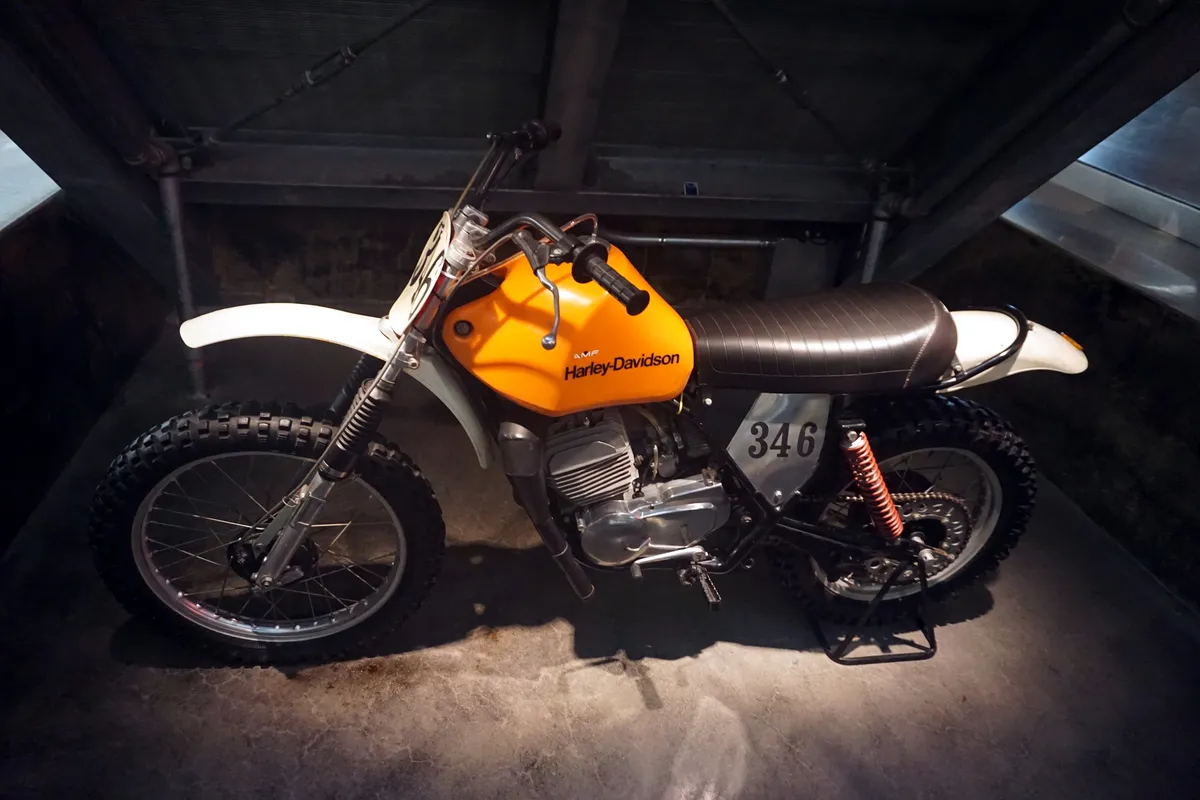
Harley's own ownership was wobbling through the same years: AMF took over the Motor Company in 1969, and the Italian bikes of the seventies are AMF Harley-Davidsons — the AMF script is right there on the tank of the museum bike in this page's photo. In 1974 the remaining half of Aermacchi followed the first, and Varese became wholly Harley's. The factory's racing department, under chief engineer William Soncini, had by then switched its talent to two-strokes: the 250 and 350 cc twin-cylinder racers it developed from 1971 onwards carried Walter Villa to the 250 cc World Championship in 1974, 1975 and 1976, plus the 350 cc title in 1976. Those are Harley-Davidson's only Grand Prix wins — four world championships, won in Italy, on two-strokes, in the exact years the SX175 was in the showrooms beneath them.
It ended in 1978, when Harley sold the Varese motorcycle business to the Castiglioni brothers' Cagiva and walked away from small bikes entirely. Every Italian Harley, the SX175 included, died with that sale.
Built to chase a Yamaha
The SX family exists because of one motorcycle: Yamaha's DT-1. The DT-1 arrived in 1969 and sold around 50,000 units in its first couple of years, inventing the mass-market enduro as it went. Aermacchi Harley-Davidson's first real answer, in Motorcycle Classics' words, "came five years later with the 1973 SX125, followed quickly by the 1974 SX175 and finally the SX250" (Aermacchi's own model list dates the SX125 to 1974; the Harley-side sources say 1973). The idea was sound — proper off-road hardware, Italian-built, wearing the most famous badge in American motorcycling.
The showrooms were the problem. Motorcycle Classics again, on the SX250 but about the whole family: "Notoriously conservative, H-D dealers were loath to stock and sell the European imports," which were not considered real Harleys. A two-stroke that needed its oil tank filled separately, sold next to Electra Glides, by salesmen who hadn't asked for it — the SX175 never stood much of a chance, and its production run reflects it. Harley-Davidson's own site dates the model from 1974 to 1978; a few model lists stop it in 1976, but the factory's SS/SX workshop manual runs to 1977 and the parts catalogues list the bike through 1978. The 2stroke-nl archive puts the total built at 7,224. In the Netherlands it launched at f2,995, rising to f3,495 for 1975 — the only period price for this exact model I could find anywhere, and a reminder of how completely the paper trail for the 175 has thinned.
The engine: 174 cc of chrome-bored aluminium
Strip the badge away and the engine is proper early-seventies Italian two-stroke practice, done well. It is an air-cooled, piston-port single of 174.1 cc — 61 mm bore on a 59.6 mm stroke, dimensions it shares with the SX250, which simply bored the same bottom end out to 72 mm. The motor is all-aluminium with a chrome-plated cylinder bore, runs 10.8:1 compression, and wears rubber dampers in the cooling fins to keep the ring-a-ding from becoming a ring-a-drone. A 27 mm Dell'Orto feeds it. The spark comes from a capacitive-discharge ignition that runs separate from the battery system, so the lights and battery could come off and the bike would still run — a racer's detail on a showroom enduro.
Oil arrives the civilised way: a separate tank and a small, throttle-controlled pump metering oil to the carburettor, no premix measuring at the petrol pump. The gearbox is a wide-ratio five-speed, and it hides the neatest trick on the bike — a primary starter gear that lets you kickstart the engine in gear. Stall it on a hill or kill it on a start line and you are one kick from moving again, no fishing for neutral. Harley claimed 17 hp for the model. The only rear-wheel number in print, from Mecum's description of a 1974 example, is 13 hp — the usual seventies gap between the brochure and the back wheel, and the honest figure to keep in your head.

SX175 specifications — the numbers that survive checking
| Item | Figure |
|---|---|
| Production | 1974–1978 (a few model lists end it in 1976) |
| Built | Varese, Italy, by Aermacchi for Harley-Davidson |
| Engine | 174.1 cc air-cooled two-stroke single, piston-port |
| Bore × stroke | 61 mm × 59.6 mm |
| Compression | 10.8:1 |
| Power | 17 hp (factory claim); 13 hp at the rear wheel (Mecum's description of a 1974 bike) |
| Carburettor | 27 mm Dell'Orto |
| Ignition | Capacitive-discharge (CDI), independent of the battery |
| Lubrication | Throttle-controlled oil injection, separate tank |
| Gearbox | 5-speed, wide-ratio; kickstart in gear via primary starter gear |
| Suspension | Marzocchi forks (see the note below); twin rear shocks, five preload positions |
| Brakes | Drums, front and rear |
| Weight | About 240 lb (109 kg) all-up — Mecum's catalogue figure |
| Production total | 7,224 (2stroke-nl Aermacchi archive) |
What is not in that table matters as much as what is. No top speed, no tank capacity, no dry weight and no drum sizes appear, because no source I trust prints them for this model — other websites state all four, contradict each other while doing it, and cite nothing. The figures above are the ones with a name behind them.
Chassis and kit: enduro clothes, Italian tailoring
For a bike its own dealers didn't want, the SX175 was dressed seriously. The 2stroke-nl archive's equipment list reads like an enduro rider's shopping list: cross-braced handlebars, serrated metal foot pegs, a high front guard, an upswept exhaust with heat shields, indicators for the road, and both a speedometer and a tachometer — plenty of stripped-down trail bikes of the day made do with neither. The rear hub is an ISDT-pattern quick-change design, the six-days-trial trick that lets a wheel come out fast without disturbing the chain and sprocket. The rear shocks adjust through five preload positions. A spark arrestor was built in, which mattered for American off-road land even then.
The front end is the one place the record argues with itself. Motorcycle Classics credits the SX family with adjustable Marzocchi suspension, and Mecum's 1974 lot lists "32mm Marzocchi front forks" in its highlights — then says "Ceriani forks up front and Betor shocks out back" in its own story text, on the same page. Both firms supplied half the Italian industry in those years, and fitment may well have varied by year or market. I print Marzocchi because two of the three mentions say so; the disagreement is recorded here rather than smoothed over. Brakes are drums at both ends — no size is reliably published — and Mecum's 1976 catalogue description mentions a 19-inch front wheel, which fits the enduro pattern of the family.
The family, kept separate: SX125, SS175 and SX250
Half the confusion around this bike is its relatives, so here they are, kept apart. The SX125 came first — the same idea in the 125 class, and the bike the 175 was the step up from. Its later SXT125 version, sold 1975 to 1978, actually runs the same frame as the 1975 SX175 with an upgraded 125 engine. The SS175, sold from 1975 to 1978, is the SX175's own engine in a roadgoing edition — same 174 cc, same 17 hp claim, street clothes instead of enduro clothes. If you are shopping, that distinction is the whole ballgame: an SS is not an SX with the knobs worn off.
