
Yamaha RD350 History: How a Musical Instrument Maker Built the World's Best Two-Stroke Twin
From a German DKW copy in 1955 to the reed-valve RD350 — the full engineering lineage of Yamaha's two-stroke twins, with factory specifications, period pricing, and the model-by-model changes that actually mattered.
The Yamaha RD350 — the culmination of two decades of two-stroke twin development, from the Adler-derived YD1 through to reed-valve Torque Induction.
Most RD350 histories start in 1973. That misses the point. The RD350 was not a clean-sheet design — it was the last step in a twenty-year chain of engineering decisions, each one solving a specific problem left by the model before it. Understanding that chain is what separates knowing the RD350's spec sheet from actually understanding why the bike works the way it does. This is that chain, model by model.
Yamaha's Origins: From Organs to Engines {#origins}
Yamaha Motor Co. began as a diversification project inside a musical instrument company — Nippon Gakki, founded by Torakusu Yamaha in 1887.
The four Japanese motorcycle manufacturers that dominate global roads today — Honda, Kawasaki, Suzuki, and Yamaha — are younger than they appear. In motorcycle terms, all four are post-war creations, despite their parent companies having much older industrial roots.
Soichiro Honda built his first motorised bicycle in 1946. Kawasaki Heavy Industries entered motorcycles in 1962, inheriting the Meguro factory when it acquired the struggling brand. Suzuki pivoted from textiles to two-wheelers in 1952. Yamaha's story starts earlier still — but in a very different industry.
Torakusu Yamaha founded Nippon Gakki Co., Ltd. in 1887, initially to manufacture reed organs. The company grew into Japan's largest producer of musical instruments and later manufactured aircraft components during the Second World War — experience in precision metalwork and propeller manufacture that would prove directly relevant when it came to casting and machining engine components. It was not until 1954 that Nippon Gakki decided to diversify into engine manufacturing, adopting the Yamaha name — after its founder — for the new venture. Yamaha Motor Co., Ltd. was formally established in 1955, with Genichi Kawakami as its first president.
The strategy they chose was pragmatic and widely used in Japan at the time: study the best-performing foreign designs and replicate them. It was not considered shameful. Honda did it, BSA did it, and the entire Japanese industry used reverse engineering as a shortcut to catching up with European competitors. Yamaha was simply the latest to follow the same path — and, as the following twenty years show, the one that took the process furthest.
The YA1 "Red Dragon" — Yamaha's First Motorcycle (1955) {#ya1}
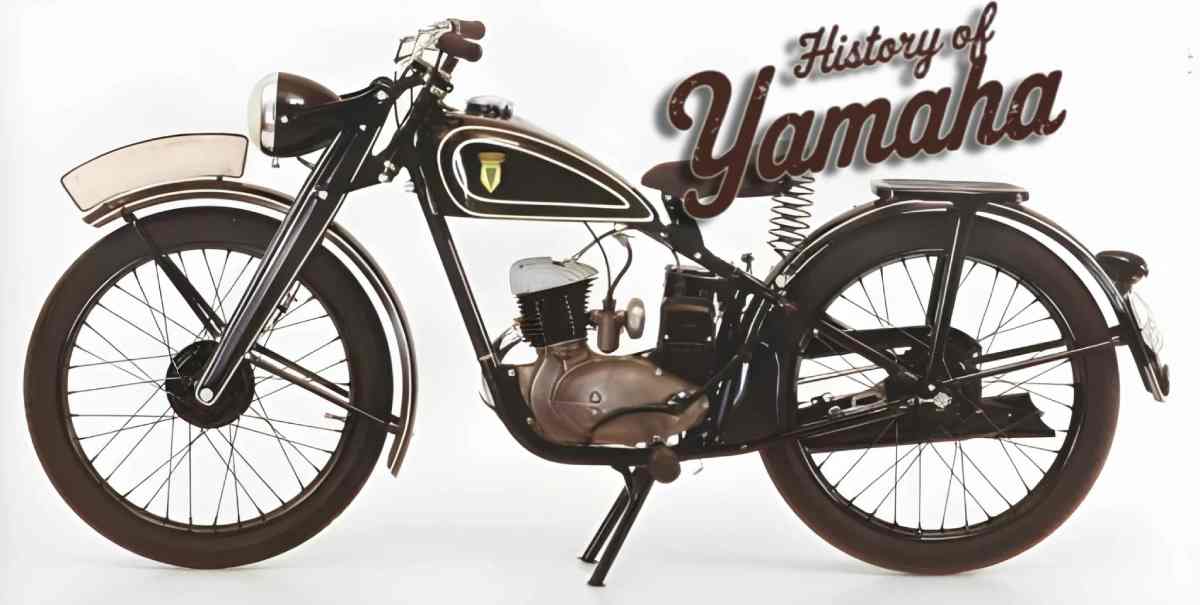
Yamaha's first production motorcycle rolled off the line in 1955 under the name YA1. It earned the nickname "Red Dragon" partly for its deep red colour, and partly because the engine was a meticulous copy of the German DKW RT125 — a 125cc single-cylinder two-stroke that had become the most widely copied motorcycle engine in history.
The DKW RT125's ubiquity is worth understanding, because it explains why so many national industries had a similar-looking starting point. As war reparations, the RT125 design was distributed to the Allied powers, which is why the same fundamental engine underpins BSA's Bantam in Britain, Harley-Davidson's Hummer in the United States, and the Moskva/Minsk line in the Soviet Union. Yamaha was in extremely large company.
A year later, Yamaha repeated the formula with a 175cc version based on the DKW RT175. The foundations had been laid. The single-cylinder philosophy would soon give way to something more ambitious.
The YD1 Twin and the Adler Connection (1956) {#yd1}
The leap to a parallel-twin engine came in 1956. For the layout and architecture of this new motor, Yamaha looked to another German manufacturer: Adler, whose MB250 was an advanced but expensive two-cylinder two-stroke that the West German market had struggled to support commercially.
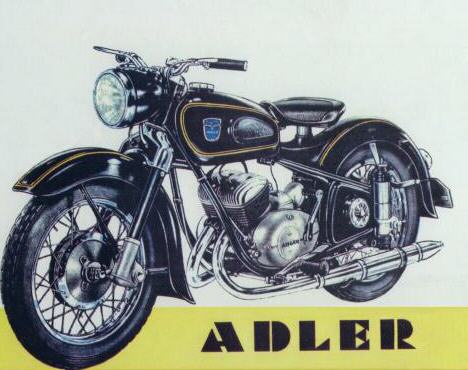
The German Adler MB250 — a sophisticated 250cc two-stroke twin whose design directly influenced the architecture of Yamaha's first parallel-twin engine, the YD1.
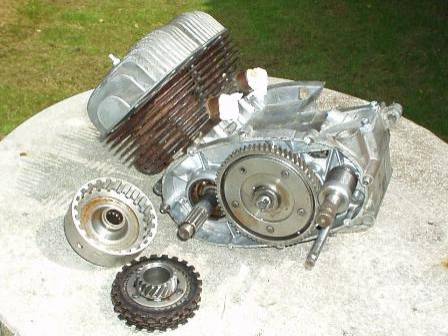
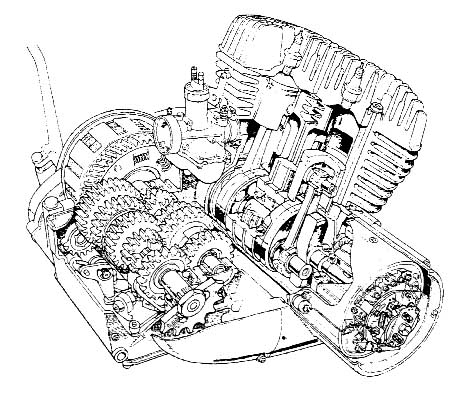
The new Yamaha twin was presented publicly as the YD1 in 1956. Yamaha engineered its own frame in-house, which was a meaningful step beyond simple copying. The engine, however, retained several characteristics of the Adler layout, most notably a secondary chain drive mounted on the left crankpin, and vertically-split crankcases — a design approach that would persist, largely unchanged, for nearly ten years.

The Yamaha YD1 (1956) — Yamaha's first parallel-twin two-stroke. Note the single carburettor feeding both cylinders, a configuration revised in later YDS models.
A single carburettor fed both cylinders on the YD1. It was a compact, air-cooled layout that stripped away the rocker-arm front suspension and plunger rear suspension that Yamaha engineers disliked on the Adler, giving the YD1 a more modern road feel. Despite the conservative engine internals, the YD1 established the DNA of everything that would follow over the next two decades.
The YD series also spawned a competition offshoot. Races in Japan — steep hillclimb-style events known as the Asama races — led to the YDS1 under the YD-series performance banner, and this bike eventually formed the basis for the TD1C factory racer. This is the point at which Yamaha's road and racing two-stroke development began feeding each other, a relationship that defines everything that follows on this page.
YDS3 — The First Real Performance Leap (1964) {#yds3}
By 1960, the YD series had found export markets. The YD2 was selling outside Japan — quietly, without making much noise — and Yamaha was learning what international riders expected. The answer came in 1964 with the YDS3, a model that addressed most of the shortcomings of its predecessors in a single revision.
The Yamaha YDS3 (1964) — separate carburettors for each cylinder, cast-iron cylinders, and a tubular frame borrowed directly from Yamaha's racing programme.
The YDS3 introduced individual carburettors for each cylinder — a move that finally unlocked the full potential of the parallel-twin layout. This is a more significant change than it sounds: a single carburettor feeding two cylinders through a shared manifold can never deliver equal mixture to both, and every subsequent Yamaha twin, including the RD350, carries twin carbs for exactly this reason. Carburettor balance between cylinders remains a core tuning discipline on these engines to this day — see our Carburetor Tuning guide.
The brakes were improved substantially, and the tubular steel frame was updated and derived directly from Yamaha's racing machines. The result sold well, particularly in the United Kingdom.

The Yamaha YD3 touring variant — one of the last models to carry the unchanged internal architecture inherited from the original Adler-inspired YD1 engine.
Alongside the YDS3, Yamaha also released a 305cc variant called the YM1, and a touring version of the YD3. The YDS3 remains historically significant as the last model built fully on the original Adler-derived concept. Everything after it represented a cleaner break.
DS5 to DS6 — Refining the Concept (1966–68) {#ds5}
The number four is considered unlucky in Japanese culture, so Yamaha skipped directly from the YDS3 to the DS5 in 1966. The DS5 brought two major engineering changes that had been overdue for years.
The Yamaha DS5 (1966) — the clutch moved from the crankshaft to the primary gearbox shaft, cast-iron cylinders gave way to aluminium, and an electric starter appeared for the first time.
First, the clutch was moved off the crankshaft and repositioned on the primary gearbox shaft. This eliminated a source of persistent mechanical grief that had afflicted every model back to the YD1. Second, cast-iron cylinders were replaced with aluminium — lighter, better at conducting heat away from the bore, and more appropriate for a performance-oriented engine. The DS5 also gained an electric starter, a first for this family of bikes, though it proved unreliable in practice.
The large crankshaft assembly caused vibration that wore bearings and engine casings prematurely — a characteristic worth understanding if you own a later air-cooled RD, since the vibration behaviour of a solid-mounted parallel twin remains a genuine ownership consideration rather than a historical footnote.
Despite these problems, the DS5 engine fundamentally delivered strong performance. Its successor, the DS6, was the final evolution of this generation — every last engineering possibility of the YD1's crankcase concept had been used up.
Why the jump from YDS3 to DS5? In Japanese, the number four (四, shi) is phonetically identical to the word for death. Yamaha, like many Japanese manufacturers, routinely skips the number four in product naming.
The R1, R5, DS7 and the Birth of the RD (1967–72) {#r1-rd}
While the DS6 squeezed the last performance from the old design, Yamaha's engineers were working in parallel on an entirely new architecture. In 1967, they unveiled the R1 (YR1) — a 347cc parallel twin with horizontally-split crankcases, a labyrinth crankshaft seal, and aluminium cylinders.
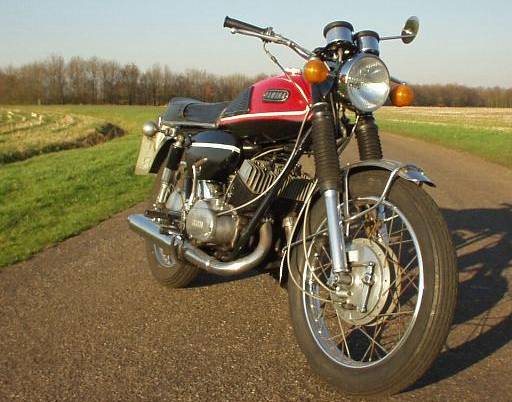
The Yamaha R1 (YR1), 1967 — Yamaha's first genuinely new engine architecture. Horizontally-split crankcases, a labyrinth crankshaft seal, and aluminium cylinders set it apart from everything before it.
The horizontally-split crankcase is the single most important change in this entire history. Vertically-split cases — the Adler-derived layout Yamaha had used since 1956 — make crankshaft support and sealing awkward and limit how much power the bottom end can reliably handle. Splitting the cases horizontally gives better bearing support, easier assembly, and a stiffer structure. Every subsequent RD, including the RD350, RD400, LC and YPVS, uses this architecture. If you have ever split the cases on an RD350, you have worked on a direct descendant of this 1967 decision.
The R1 was a revelation. Concerns about cooling a 350cc air-cooled two-stroke had made engineers cautious, but the bike performed beyond expectations. Its 1968 successor, the R2, was never officially sold in many markets, but it is regarded by many historians as among the finest two-strokes Yamaha ever made — characterised by straight exhausts and a headlight with an integrated instrument cluster. The R3 followed with five-port cylinders and twin clocks.

The DS-series evolution — the development path from the DS5 through to the DS7, as Yamaha progressively mastered the parallel-twin two-stroke layout.
On the 250cc side, the DS6 concept was replaced by the DS7 — a properly modern machine with horizontally-split crankcases and aluminium cylinders. The DS7 was widely considered a superb road bike and, together with the R5, represented the pinnacle of Yamaha's two-stroke knowledge at the start of the 1970s.
The R5, introduced in 1970, is the direct parent of the RD350. It carried the same 64mm bore and 54mm stroke that the RD350 would use, a five-speed gearbox, piston-port induction, and drum brakes front and rear.

Engineering development leading to the RD350 — by the early 1970s Yamaha had mastered the horizontally-split crankcase twin and was refining porting, reed valves, and intake geometry.
In the early 1970s, Yamaha made one decisive mechanical change to both the R5 and DS7 families: reed valves were added to the intake systems. This single modification transformed low-end throttle response and broadened the power band considerably. To reflect the change, both model families were renamed under the new RD designation.
What Does "RD" Actually Stand For? {#rd-meaning}
This is one of the most-asked questions about these bikes, and the honest answer is that it's contested.
The widely repeated explanation is "Race Developed" — a reading endorsed by a great many respected outlets. Hagerty states plainly that <cite index="24-1">the RD initials stood for Race Developed, and helped differentiate the new twin from its similarly styled predecessor, the YR5</cite>, and argues <cite index="24-1">the slogan was justified, since Yamaha's TZ two-stroke twins had dominated club- and national-level 250cc and 350cc racing worldwide for several years</cite>. Rider Magazine and Visordown use the same reading.
The competing account holds that RD is simply a factory model code — R for road, D for two-stroke — fitting a wider Yamaha naming system in which DT is two-stroke trail and XS is four-stroke street, and that <cite index="29-1">"Race Developed" was a tag coined by a UK marketing department in the late 1970s</cite> rather than an official designation. RevZilla, notably, declines to settle it, observing that <cite index="21-1">RD stands for "Race Developed" — or it doesn't, depending on what you've read</cite>.
The defensible position: "Race Developed" is the popular and widely published reading, and the racing pedigree behind it is entirely real regardless of the acronym's origin. Whether Yamaha's naming department intended it that way in 1972 is genuinely unresolved. Anyone telling you definitively either way is overstating the evidence.
The Yamaha RD350 — Reed Valves and a New Era (1973) {#rd350}
The Yamaha RD350 entered production in 1973 and remained in the lineup through 1975. Evolved from the R5, the RD350 introduced a 6-speed gearbox, a reed-valve intake system branded Torque Induction, and Yamaha's Autolube automatic oil injection, which metered two-stroke oil at the carburettor inlet and eliminated the need for pre-mixed fuel.
The reed valve is the defining change, and it's worth being precise about what it does. A reed valve is a one-way check valve in the intake tract: it opens under crankcase vacuum to admit charge and closes to prevent that charge blowing back out through the carburettor at low rpm — the characteristic weakness of a piston-port two-stroke. The result is stronger low-end torque and a usably broader power band, which is exactly what "Torque Induction" was describing. For the full walkthrough — how the reeds open and close, and how to check them — see Yamaha Torque Induction explained. For how this affects tuning decisions today, see our Modification Engine porting guide.
The engine was a 347cc air-cooled parallel twin producing 39 bhp at 7,500 rpm in US specification. The frame geometry borrowed directly from Yamaha's TZ250 and TZ350 racing bikes, with a 27-degree fork rake that gave handling well beyond what the displacement suggested. Braking was a single front disc — advanced for the class in 1973 — paired with a rear drum.
Contemporary reviewers were emphatic. Cycle World described the RD350 as a café racer's delight, praising strong acceleration from 3,500 to 8,000 rpm, near-neutral steering, and roadholding helped by the double-cradle frame and front disc.
Yamaha RD350 Specifications and Period Pricing {#specs}
| Specification | 1973–75 Yamaha RD350 (US spec) |
|---|---|
| Engine | 347cc air-cooled two-stroke parallel twin, reed-valve Torque Induction |
| Bore × stroke | 64mm × 54mm |
| Power | 39 bhp @ 7,500 rpm |
| Compression ratio | ~6.2–6.6:1 (source-dependent) |
| Carburettors | 2 × 28mm Mikuni |
| Transmission | 6-speed |
| Lubrication | Autolube automatic oil injection |
| Frame | Cradle-type tubular steel, TZ-derived geometry, 27° rake |
| Brakes | Single front disc, rear drum |
| Wheels | 18-inch chrome wire-spoked (1.85in front / 2.15in rear typical; UK 1.60/1.85in) |
| Tyres | 3.00-18 front, 3.50-18 rear |
| Wheelbase | ~1,320mm (52 in) |
| Seat height | ~800mm (31.5 in) |
| Weight | ~143kg (315 lb) dry / ~155kg (341 lb) wet |
| Top speed | ~100–105 mph |
| 1973 US list price | $839 |
| 1975 US list price | $1,071 |
A note on the weight figure: published sources differ, and it's usually a dry-versus-wet distinction rather than a genuine disagreement. Grokipedia and Hagerty both cite approximately 143kg (315 lb) dry, rising to around 341 lb wet; some period sources list 152kg and one dealer reference lists 163kg dry for the RD350B. When comparing against another bike's figures, check which measure you're reading.
On price, the RD350's value proposition is the part most often understated. Cycle World's February 1973 issue listed it at $839 — against $1,350 for Yamaha's own TX500 four-stroke twin in the same showroom. By 1975 the RD350 had risen to $1,071, roughly a 25% increase across three model years. That price gap, combined with genuine race-derived handling, is the origin of the RD350's enduring reputation as the affordable club racer's bike.
RD350A vs RD350B: How to Tell Them Apart {#a-vs-b}
Two variants were produced in the RD350's three-year run, and the distinction matters when sourcing parts or verifying a bike's originality:
- RD350A (1973) — the launch model.
- RD350B (1974–75) — detail revisions to jetting, electrical components, and paint/graphics schemes.
The differences are minor mechanically, but they are not zero, and parts listings frequently conflate them. Colour and decal schemes are among the more reliable identifiers for a given model year — a point long-time owners will confirm, and a common source of mislabelled bikes in the classifieds. When verifying a bike, work from frame and engine numbers against factory documentation rather than from paint. Our RD350 Workshop Manual carries the relevant factory specifications.
How the RD350 Compared to Its 1973 Rivals {#rivals}
The 350 class in 1973 was genuinely competitive, and the RD350's positioning within it explains its reputation better than any single spec figure:
| Bike | Configuration | Character |
|---|---|---|
| Yamaha RD350 | 347cc two-stroke twin, 39 bhp | Race-derived handling, broad reed-valve power, light |
| Kawasaki S2/350 triple | 346cc two-stroke triple | Quicker in a straight line, demanding to ride hard |
| Honda CB350 | 325cc four-stroke twin | Smoother and more civilised, notably slower |
| Suzuki GT380 | 371cc two-stroke triple | Strong performer, heavier and more touring-oriented |
The RD350's advantage was never peak output — it was the combination of low weight, a genuinely race-derived chassis, and a power band made usable by reed valves. That's why period road tests repeatedly noted it could embarrass much larger machinery on anything other than a dead straight road.
RD400 and the Final Air-Cooled Evolution (1976–79) {#rd400}
In 1976, Yamaha introduced the RD400C, followed by the RD400D, RD400E, and finally the RD400F Daytona Special in 1979 — the last air-cooled RD sold new. These models progressively refined the design to meet tightening emissions regulations, primarily in North America.
The RD400 gained a rear disc brake, revised frame and suspension, and — in later US-market form — significant changes to induction and exhaust in pursuit of emissions compliance. Power was modestly reduced from peak RD350 levels, though handling and braking continued to improve.
Usefully for owners, the RD400 shares a great deal with the RD350 mechanically, including the same 64mm bore. Its head gasket in particular is a well-known upgrade for RD350 squish and sealing work — see our Squishing guide, which covers exactly that modification.
Throughout this period, the RD family held its own against formidable competition. The Kawasaki H2 750 triple offered more raw power but was notoriously difficult to handle. The RD400's strength was balance — tractable power, precise handling, and a nimbleness heavy triples could not match in the real world.
RD350LC — Water Cooling Changes Everything (1980) {#rd-lc}
Introduced in 1980, the RD350LC (Liquid Cooled) applied water cooling to the 350cc twin. This was a significant engineering step: liquid cooling allowed tighter thermal control of cylinders and head, enabling more aggressive porting, higher compression, and a broader, stronger power band than any air-cooled RD could achieve. Output rose to around 47–49 bhp.
The LC retained the RD350's 64 × 54mm bore and stroke — meaning displacement-based parts often cross over between generations even though the top ends are entirely different. The RD350LC was developed alongside a near-identical RD250LC, distinguishable mainly by its single front disc versus the 350's twin discs.
In the UK in particular, the RD350LC acquired near-mythical status among young riders, a reputation that still drives values today.
RD350 YPVS — The Power Valve Era (1983–86) {#ypvs}
The RD350 YPVS — sold as the RZ350 in the United States — added the Yamaha Power Valve System, a servo-controlled valve that alters exhaust port height with rpm. The effect is to give the engine the top-end port timing of a race motor without sacrificing the low-rpm tractability that a fixed high exhaust port destroys. The technology came directly from Yamaha's Grand Prix programme, where it had been in use since the late 1970s.
The gain was substantial: contemporary reporting put the YPVS-era RD350 at around 59 hp, with the RD250 rising to roughly 46 hp — meaning the 250 now matched what the previous generation's 350 had produced.
Later variants included the RD350F (full fairing) and RD350N (naked, round headlight), and production eventually moved to Brazil, where YPVS-derived machines were built as the RD350R until the mid-1990s.
If you own a YPVS bike, the power valve itself is a genuine maintenance item — a sticking or mis-calibrated valve mimics ignition and carburetion faults. Our Ignition Timing and Basic 2-Stroke Tuning guides cover the diagnostic sequence.
RD500LC — The V4 Flagship (1984–86) {#rd500}
The RD500LC (RZ500 in Canada and Australia; RZV500R in Japan) was the road-going interpretation of Kenny Roberts' YZR500 Grand Prix machine. Built between 1984 and 1986, it used a 499cc liquid-cooled two-stroke V4 in a 50-degree twin-crankshaft layout, fed by four Mikuni carburettors, producing 88 hp at 9,500 rpm and 66 Nm at 8,500 rpm.
An important clarification for anyone shopping parts: the RD500LC is a different engine family from the parallel-twin RDs. Porting knowledge, tuning parts, and most components do not transfer from an RD350 to an RD500.
The Indian Rajdoot 350 — A Different Story (1983–90) {#rajdoot}
While the global RD story wound down, a parallel chapter unfolded in India. The Rajdoot 350 — manufactured by the Escorts Group under licence from Yamaha — entered production in 1983 based on RD350B architecture, sold under the Rajdoot brand.
Two variants were produced:
| Variant | Power | Notes |
|---|---|---|
| High Torque (HT) | ~30.5 bhp | Wider exhaust ports; the variant behind the "Rapid Death" nickname |
| Low Torque (LT) | ~27 bhp | Introduced 1985; tuned for economy and smoother delivery |
Both were detuned from the RD350B's 39 bhp to suit Indian fuel quality and improve economy, and both replaced the export model's front disc with drum brakes front and rear. The HT was capable of roughly 160 km/h and 0–60 km/h in about four seconds, making it comfortably the fastest production motorcycle available in India at the time.
Fuel thirst worked against it in a market where economy was paramount. The LT attempted to address this, but a new generation of efficient four-stroke commuters was arriving from Hero Honda and others. Production ceased in 1990, by which point the bike had been almost entirely indigenised.
Today, well-maintained examples command significant prices among Indian collectors, and a thriving restoration community keeps HT and LT variants alive nationwide. Note that Indian-market values and US Hagerty figures are not interchangeable — these are separate collector markets for mechanically different bikes. See Specifications for the full HT/LT comparison.
Why the RD Series Ended {#why-ended}
The RD line did not die of technical failure — it was legislated out of existence. Tightening emissions regulations, first in the United States and then progressively worldwide, made the two-stroke's fundamental combustion cycle untenable for road use. A crankcase-scavenged two-stroke loses a portion of its fresh charge straight out of the exhaust port during scavenging, and burns oil by design. No amount of porting refinement solves either problem.
Yamaha's own hedging is visible in period product strategy: by the mid-1970s, the company was directing its marketing budget toward the four-stroke TX series, priced well above the two-stroke twins, in anticipation of exactly this outcome.
The RD Legacy {#legacy}
The thread running from Torakusu Yamaha's 1887 organ factory to the RD350's reed-valve twin is, at first glance, a strange one. But the logic is consistent throughout: identify the best available technology, understand it completely, then improve on it. The YA1 was a copy. The YD1 was an adaptation. The YDS3 was a refinement. The R5, DS7, and RD350 were original machines that left every model before them behind.
That is how the world's largest musical instrument manufacturer became the builder of one of the most celebrated two-stroke motorcycles of the twentieth century — one that still commands respect, restoration budgets, and open throttles more than fifty years after it was designed.
FAQ {#faq}
Q-1: What does RD stand for on a Yamaha RD350?
1: It's genuinely contested. The widely published reading is "Race Developed," endorsed by Hagerty, Rider Magazine and others, and the underlying racing pedigree is real — Yamaha's TZ250 and TZ350 twins dominated club and national racing in the period. A competing account holds that RD is simply a factory type code (R for road, D for two-stroke, matching DT for two-stroke trail and XS for four-stroke street), with "Race Developed" coined later by UK marketing. Anyone stating either version as settled fact is overstating the evidence.
Q-2: What year was the Yamaha RD350 made?
2: The original air-cooled Yamaha RD350 was produced from 1973 to 1975, in RD350A (1973) and RD350B (1974–75) form. It was succeeded by the RD400 (1976–79). Separately, the Indian-built Rajdoot/RD350 ran from 1983 to 1990, and YPVS-derived machines continued in Brazil as the RD350R into the mid-1990s.
Q-3: How much horsepower does a Yamaha RD350 have?
3: 39 bhp at 7,500 rpm in US/export specification. The liquid-cooled RD350LC raised this to roughly 47–49 bhp, and the YPVS-equipped version to around 59 hp. Indian-market variants were detuned: approximately 30.5 bhp for the HT and 27 bhp for the LT.
Q-4: What was the RD350's predecessor?
4: The Yamaha R5 (YR5), introduced in 1970 — a 347cc, five-speed, piston-port twin with drum brakes front and rear. The RD350 used the same 64mm bore and 54mm stroke but added reed valves, a sixth gear, and a front disc brake. Further back, the lineage runs through the R1 (1967, the first horizontally-split crankcase Yamaha twin), the DS5/DS6, the YDS3, and ultimately the Adler-influenced YD1 of 1956.
Q-5: What is Torque Induction on a Yamaha RD350?
5: Torque Induction is Yamaha's marketing name for the RD350's reed-valve induction system — not a separate engine or trim level. The reed valve acts as a one-way check valve that admits fresh charge under crankcase vacuum and prevents it blowing back out through the carburettor at low rpm. The practical result is stronger low-end torque and a broader usable power band than the piston-port R5 it replaced.
Q-6: How much did a Yamaha RD350 cost new?
6: Cycle World listed the 1973 RD350 at $839 in the US. By 1975 the price had risen to $1,071 — roughly a 25% increase across three model years. For context, Yamaha's own TX500 four-stroke twin sold for $1,350 in 1973, which is central to why the RD350 became the affordable club racer's machine.
Q-7: How much does a Yamaha RD350 weigh?
7: Approximately 143kg (315 lb) dry, rising to roughly 155kg (341 lb) wet. Published figures vary between sources, usually because of the dry-versus-wet distinction rather than genuine disagreement — always check which measure a spec sheet is quoting before comparing bikes.
Q-8: What's the difference between the RD350 and the RD350LC?
8: The RD350 (1973–75) is air-cooled with fixed port timing and roughly 39 bhp. The RD350LC (from 1980) is liquid-cooled, allowing more aggressive porting and higher compression for around 47–49 bhp. Both share the 64 × 54mm bore and stroke, so some displacement-based parts cross over, but the top ends are entirely different designs.
Q-9: Is the Indian Rajdoot 350 the same as the Yamaha RD350?
9: Mechanically closely related but not identical. The Rajdoot 350 was built by the Escorts Group under licence from 1983 to 1990 on RD350B architecture, but detuned to roughly 30.5 bhp (HT) or 27 bhp (LT) and fitted with drum brakes front and rear rather than the export model's front disc. It is a distinct collector market from the US-spec RD350.
Q-10: Why did Yamaha stop making the RD350?
10: Emissions regulation, not technical shortcoming. A crankcase-scavenged two-stroke inherently loses unburnt charge out of the exhaust port during scavenging and burns oil by design — neither issue can be engineered away through porting. Tightening rules, starting in the United States, progressively made two-stroke road bikes unviable.
Related RD350 Resources {#related}
- Specifications — full model-by-model spec sheets including US, LC, YPVS and Indian HT/LT variants.
- Bike Myths — common RD350 misconceptions, including several historical ones.
- Torque and Horsepower — how the RD's output figures were measured and what they mean.
- RD350 Tuning: More Power — the tuning path from stock to modified.
- Modification Engine — porting and cylinder head work on the reed-valve twin.
- Squishing: The Art of Squish — including the RD400 head gasket upgrade referenced above.
- Carburetor Tuning — twin-carb balance, the discipline introduced with the YDS3.
- Ignition Timing and Ignition Modification — points setup and electronic conversion.
- Maintenance — keeping a fifty-year-old two-stroke running properly.
- RD350 Workshop Manual — factory specifications for verifying originality.
Written by RahilJK (TorqueInductions) — restorer and long-time rider of classic two-stroke Yamaha motorcycles including the Jawa 250, RD350, and RX100. Technical details sourced from factory documentation, period road tests, and hands-on workshop experience. About the author →