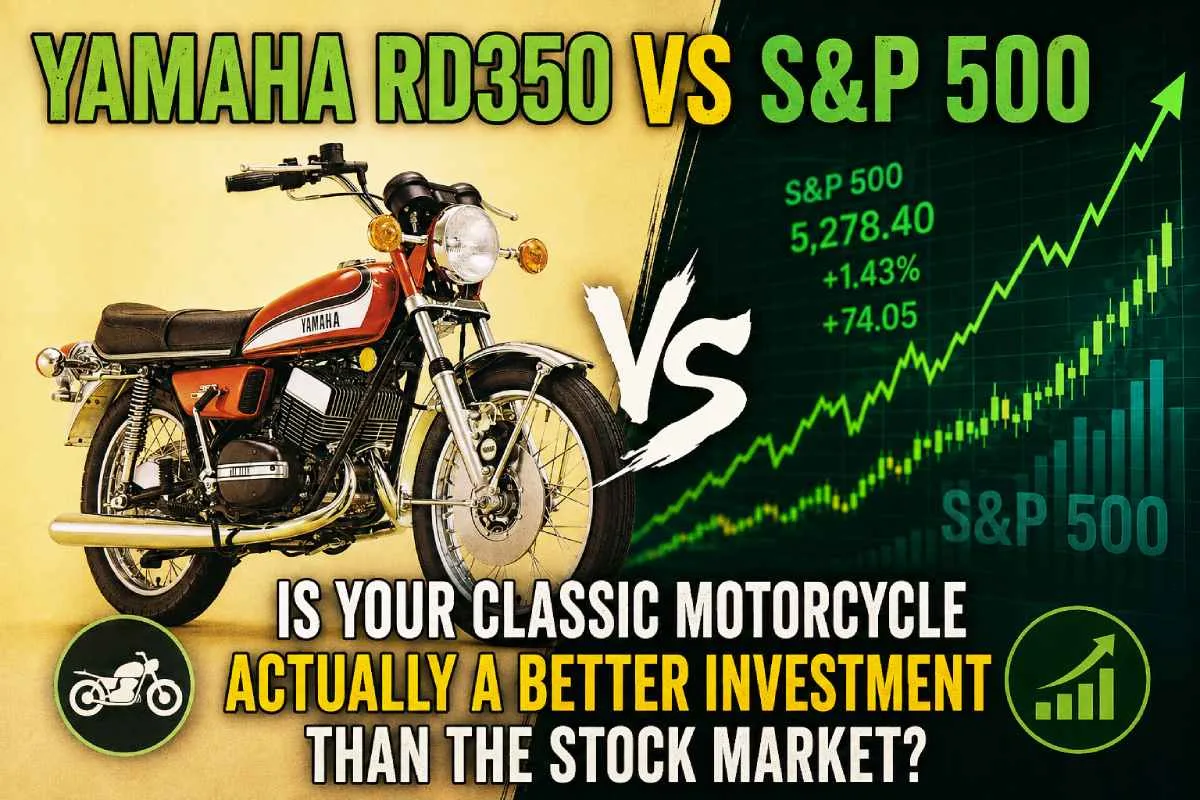
Yamaha RD350 vs S&P 500: Is Your Classic Motorcycle Actually a Better Investment Than the Stock Market?
**Excerpt:**
Could a Yamaha RD350 really outperform the S&P 500 as an investment? This in-depth comparison examines **Yamaha RD350 appreciation, classic motorcycle prices, S&P 500 returns, inflation, maintenance costs, restoration expenses, liquidity, and investment risk** to find out whether owning a legendary two-stroke is simply a passion—or a surprisingly strong alternative investment.
By shoprd209 views
Advertisement
Yamaha RD350 vs. S&P 500: What an RD-Series Expert Actually Thinks About "Investing" in a Two-Stroke
By an RD-series specialist covering the Yamaha RD350, RD400, RD350LC/YPVS, and the wider RD family. Figures below are cross-checked against Hagerty's live valuation tool and recent completed sales rather than repeated from unverified secondary sources — where a number can shift quarter to quarter, that's noted explicitly.
You'll find "classic motorcycle investment" articles that treat an RD350 like a ticker symbol — a straight-line chart from $1,200 to $14,000 with a tidy CAGR attached. That's not how these bikes actually trade, and it's not the most useful way to think about buying one. This article keeps the comparison people are searching for — RD350 value versus the stock market — but answers it the way someone who actually buys, sells, and wrenches on these bikes would: what really drives an RD350's price, which variant you're even talking about, and what a straight financial comparison misses.
What Is a Yamaha RD350 Actually Worth Right Now? {#current-value}
Pull up Hagerty's live price guide rather than a static chart, and the picture is more modest — and more volatile quarter to quarter — than the "steady 7-8% annual appreciation" narrative that circulates in classic-bike investment content. As of mid-2026, a #3 "Good condition" 1975 RD350B is valued around $4,167–$5,767, and that figure was actually down slightly (-4.1%) over the prior year, against a +14.6% gain over the trailing three years. Independent market coverage of recent completed sales puts clean RD350s in a roughly $2,000–$14,000 range overall, with most well-sorted examples actually trading in the $3,500–$9,600 band — nowhere near the $18,000+ "excellent condition" figures sometimes quoted for cherry-picked auction results.
That range matters more than any single average, because — as covered below — "an RD350" isn't one bike with one price; it's a family of variants with genuinely different values.
Practical takeaway: treat any RD350 "market value" you read, including the figures in this article, as a starting range to sanity-check against Hagerty's tool and current completed listings at the time you're actually buying or selling — not a number to plan a portfolio around.
Why "RD350 Price" Is the Wrong Question — Which RD Are You Pricing? {#which-rd}
Anyone searching "what's my RD350 worth" needs to answer this first, because it changes the number by thousands of dollars:
US/export-spec RD350 (1973) and RD350B (1974–75): the original air-cooled, 39-bhp, disc-front-brake models — this is what most Western collector pricing (including the Hagerty figures above) actually refers to.
RD400 (1975–80): shares most parts and tuning knowledge with the RD350 but is a different, slightly larger-displacement model with its own, generally somewhat higher, collector following.
RD350LC (1980–83) and RD350 YPVS/RZ350 (1983–86): liquid-cooled, later-generation bikes with different collector demographics — often valued more on running condition and originality of the power-valve system than on the "vintage air-cooled" nostalgia that drives US RD350B pricing.
Indian-market RD350 HT/LT (1983–1990, built by Escorts as the Rajdoot 350): a mechanically related but distinct, detuned, drum-braked variant with its own separate collector market in India, generally not directly comparable to US Hagerty figures.
If you're pricing a specific bike, confirm which of these it actually is — VIN/frame number, market of origin, and original spec — before anchoring to any published "RD350 value." For the full spec breakdown across these variants, see Specifications.
What Actually Moves an RD350's Price: A Mechanic's-Eye View {#what-drives-price}
This is where genuine RD-series knowledge matters more than market-report quotes. In rough order of price impact:
Numbers-matching engine and frame. An engine case, frame, and title that all trace to the same original bike is the single biggest driver of premium pricing in this market — and it's also the easiest thing for an inexperienced buyer to miss, since decades of parts-swapping and "donor bike" rebuilds are common on RD350s specifically.
Mechanical originality vs. modification. A period-correct, unmolested bike commonly commands more than a well-executed performance build, even though the modified bike may run better — collector value and rideability value are different things on this model.
Condition of wear-prone, hard-to-source parts. Reed valves, expansion chambers, and correct-spec carburetors are consumable or easily-lost items on an RD350; a bike that retains its original chambers and reed cage is worth checking closely, since replacements are a real, ongoing cost (see the internal links below for what those parts actually involve).
Documentation. Title, service history, and ownership record — standard collector-vehicle logic, and no different for an RD350 than any other classic.
Engine health independent of cosmetics. A visually excellent RD350 with detonation damage, worn transfer ports, or a mistimed ignition (see the Squishing and Ignition Timing guides) is worth meaningfully less than the same bike mechanically sound — and this is genuinely hard for a non-specialist buyer to assess without a pre-purchase inspection by someone who knows this specific engine family.
Yamaha RD350 vs. S&P 500: The Honest Comparison {#vs-sp500}
The stock market side of this comparison is well-documented and doesn't need hedging the way RD350-specific pricing does. The S&P 500's long-run total return (dividends reinvested) has compounded in roughly the 10–13% annual range over most 10+ year windows since 2000, including two severe drawdowns (-37% in 2008, -18% in 2022) that it recovered from within a few years each time.
Advertisement
Set against the real RD350 range above — a bike that's shown roughly flat-to-modest appreciation over the past year and a mid-single-digit percentage gain over three years, depending on variant and condition — the stock market's long-run compounding is the stronger pure financial return over most extended holding periods. That's consistent with how collector-vehicle markets generally behave versus equities: classic vehicles can hold value well and occasionally spike, but they don't compound the way a diversified equity index does, and they carry real carrying costs (insurance, storage, maintenance, and a much less liquid resale process) that an index fund doesn't.
Where the comparison gets more interesting is volatility, not return: classic motorcycle values, like other collector assets, tend to be less correlated with equity market swings — they didn't fall anywhere near as hard as stocks did in 2008 or 2022, even if they don't compound as fast in calm markets either. That's a genuine diversification argument, distinct from (and more defensible than) a "beats the market" argument.
Why Classic Motorcycles Get Compared to the Stock Market at All {#why-compare}
Wealth managers do increasingly treat "passion assets" — classic vehicles, watches, art — as a small, deliberate slice of a diversified portfolio, generally in the single-digit-to-low-teens percentage range for collectors who are already meeting their core retirement and liquidity goals. The reasoning isn't that an RD350 will outperform an index fund; it's that a small allocation to an asset with low correlation to equities, that you'd own anyway for non-financial reasons, is a defensible piece of an already-solid financial plan — not a substitute for one.
What the Data Doesn't Capture {#experiential}
This part doesn't need inflated statistics to be true: an RD350 is one of the more genuinely engaging small-displacement classics to actually ride, and that's real value that a price chart can't represent. The reed-valve "Torque Induction" powerband, the mechanical simplicity of a points-ignition two-stroke twin, and the active, hands-on maintenance this bike demands are exactly why it has the following it does — separate from, and arguably more durable than, its resale chart.
If You're Buying an RD350 With Value in Mind {#buying-smart}
Confirm the variant and numbers-matching status before you negotiate on price — a mismatched-numbers RD350B and a matching-numbers one are not the same purchase, even if they look identical.
Get a pre-purchase inspection from someone who knows RD-series engines specifically, not a generalist — squish clearance, port condition, and ignition timing are all things a cosmetic inspection will miss (see Squishing and Ignition Timing for what "correct" actually looks like on this engine).
Price against current completed sales, not a headline auction result. The $14,000+ examples that make it into "investment" articles are the top of a wide range, not the median.
Budget for real ongoing costs — insurance, periodic maintenance, and parts sourcing on a 50-year-old two-stroke are genuine, recurring expenses, not a one-time purchase price.
Buy the bike you'll actually maintain and ride. On this specific model, an unused, badly stored example depreciates in real mechanical terms (seized parts, degraded fuel systems, corroded chambers) faster than most classics — see Maintenance for what that upkeep actually involves.
FAQ Frequently Asked Questions {#faq}
Q 1-Is a Yamaha RD350 a good investment?
As a pure financial instrument, no — long-run equity index returns have generally outpaced RD350 appreciation, and RD350 values have shown real short-term volatility (including a recent slight decline in Hagerty's tracked "Good condition" value). As a low-correlation collector asset you'd own for the riding experience regardless, it can be a defensible small piece of a portfolio that's already otherwise sound.
Q 2-How much is a Yamaha RD350 worth?
It depends heavily on variant and condition: current market data puts most clean, well-sorted US/export RD350s in roughly the $3,500–$9,600 range, with the wider observed range (including rougher and exceptional examples) spanning about $2,000–$14,000. Confirm current figures against Hagerty's live valuation tool and recent completed sales before pricing a specific bike.
Q 3-Does an RD350's value differ from an RD400 or RD350LC/YPVS?
Yes — these are different models with different collector markets, even though they share tuning knowledge and some parts. Don't apply RD350-specific pricing to an RD400 or YPVS without checking that model's own comparables.
Q 4-What matters most for RD350 resale value?
Numbers-matching engine/frame, mechanical originality versus modification, documentation, and — critically for this specific model — genuine mechanical health (correct squish clearance, port condition, ignition timing), which a purely cosmetic inspection won't reveal.
Q 5-Are Indian-market RD350 HT/LT models valued the same as US-spec RD350s?
No — they're a mechanically related but distinct, detuned, drum-braked variant built under license in India, with their own separate collector market. Don't use US Hagerty figures to price one.
Q 6-Should I buy an RD350 instead of investing in index funds?
Most financial guidance would frame this as "and," not "instead of" — fund retirement and emergency savings first, then consider a collector motorcycle with genuinely discretionary money and an understanding that it's primarily a passion purchase with a plausible, but not guaranteed or market-beating, chance of holding or gaining value.
Related RD350 Resources
Market values referenced above reflect data available as of mid-2026 and will shift; always confirm current figures directly with Hagerty's valuation tool and recent completed sales before making a purchase or sale decision. This article is general information, not financial or investment advice.
Specifications — full spec and variant comparison referenced above.
Yamaha RD350 History — production history and background for the models discussed here.
Bike Myths — common misconceptions about the RD350, including some that affect resale value.
Maintenance — the ongoing costs and care that factor into real ownership economics.