
Category: Maintanence

Yamaha Torque Induction Explained: The Reed Valve Behind the RD350

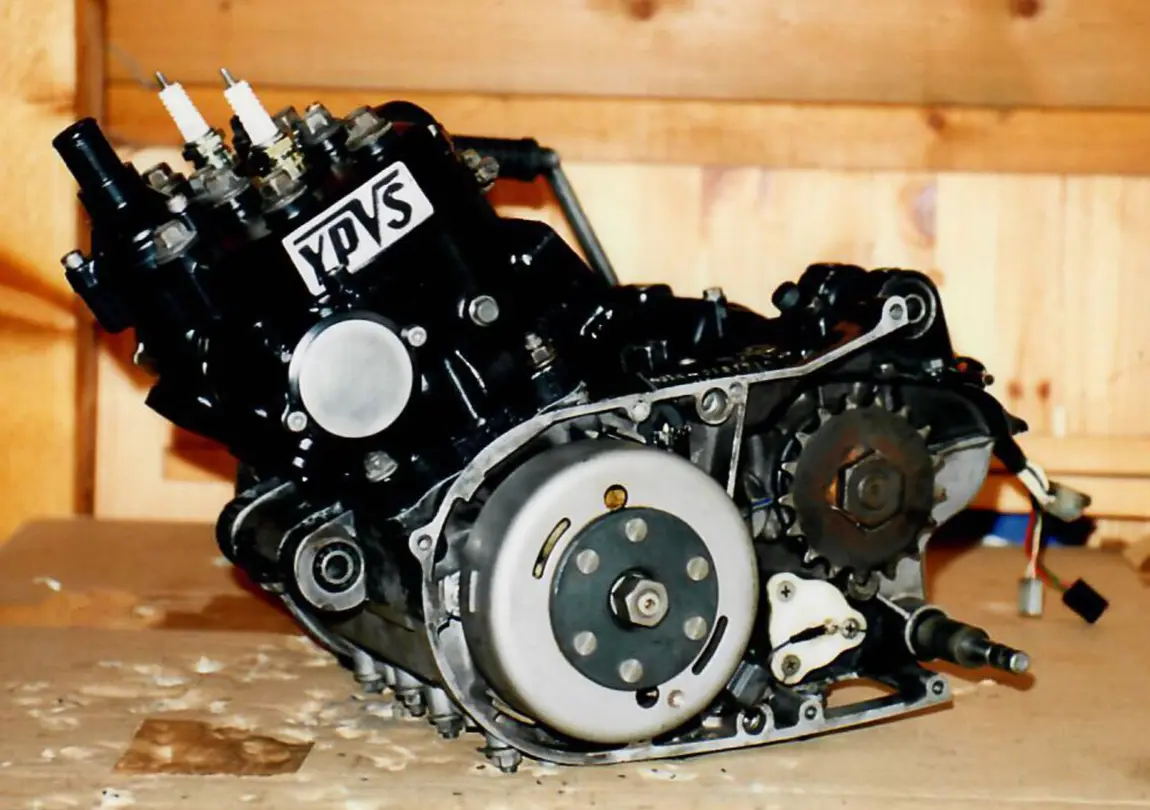
RD350 YPVS engine on the bench — FB1969, CC BY-SA 4.0, via Wikimedia Commons

By Rahil "TorqueInductions" — Torque Induction isn't history to me: it's the reed blocks I pull, clean and check on my own RD350s and my RX100. Petals first, jetting second — most "carb problems" on these bikes start at the reeds.

Torque Induction is Yamaha's name for reed-valve induction — the intake system fitted to the RD350 and its family from 1973. Between each carburettor and the crankcase sits a reed valve: a block of thin, flexible petals that open under vacuum as the piston rises, then snap shut against pressure as it falls, so the fuel charge stays trapped in the engine instead of being blown back out of the carburettor. That one-way valve is the whole idea — and it's why the RD pulls cleanly from low revs where its piston-port predecessor coughed and spat.

  Reed valve (Torque Induction) Piston port
What times the intake Crankcase pressure — the petals open and close on demand The piston skirt, at fixed crank angles
Intake timing Adapts with engine speed Symmetrical about top dead centre, fixed
Low-rpm behaviour Charge stays in the engine; clean carburetion Charge blows back out of the carb — spitting, four-stroking
Power band Broad — strong low end without giving up top end Narrow — tractability and top-end timing fight each other
Maintenance Petals wear; inspect and replace Nothing to wear at the intake

How it works

Follow one charge through an RD350. The piston rises, crankcase pressure drops, and the vacuum pulls the reed petals open off their block. Air rushes through the Mikuni, picks up fuel, passes the open reeds and fills the crankcase. Then the piston falls. Pressure rises, the petals are forced flat against the block, and the intake tract is sealed — the charge has nowhere to go but up the transfer ports into the cylinder when the piston uncovers them. Each cylinder has its own reed block between its carburettor and the crankcase, a wedge-shaped cage carrying four petals per block on the RD350.

Diagram of Yamaha Torque Induction: the intake path from carburettor through the reed block into the crankcase and up the transfer ports, showing the reed petals open as the piston rises and closed as the piston falls

A piston-port engine has none of this. Its intake port is opened and closed by the piston skirt itself, at the same crank angles every cycle, open and shut symmetrical about top dead centre. The port is still open just after top dead centre, so at low rpm the descending piston simply pushes part of the fresh charge back out through the carburettor — the fuel fog old two-stroke riders know at the carb mouth. Designers were stuck: time the port for top-end power and the engine spat and stumbled at low speed, or time it for manners and lose the top end. The reed valve ends that argument because it isn't timed by the crank at all — it answers pressure, opening when the engine asks and closing the instant pressure reverses.

Where it came from, and which models used it

Reed valves weren't Yamaha's invention — tuners were already buying aftermarket reed kits for small two-strokes in the early 1970s. What Yamaha did was productionise them: in 1973 the new RD250 and RD350 replaced the piston-port DS7 and R5, and Yamaha marketed the reed system as Torque Induction, the full period name being "7-port Torque Induction". The RD400 followed in 1976, and the liquid-cooled RD350LC of 1980 kept reed induction. India's Rajdoot 350 — a licensed RD350B built by Escorts from 1983 — carried the same "7-port Torque Induction with reed valve" engine, and Yamaha India's RX100, built 1985 to 1996, lists "reed valve, 7-port Torque Induction" in its specification to this day. I cover the RD's arrival in context in the full RD350 history.

What it changed

The numbers first: the RD350 made 38.5 hp at 7,500 rpm, about three horsepower up on the piston-port R5 it replaced, and Cycle World timed the RD over a second quicker through the quarter-mile than the R5, with 9 mph more terminal speed — the whole RD package, with the reeds as its headline engine change. But the testers' real praise was for the manners. A period tester quoted since said Torque Induction "allowed hairy intake timing without the motor suffering from low-speed indigestion". That's the change in one line: the cylinder could be ported for power because the reed, not the port timing, was minding the low end. Stronger pull from low revs, a wider usable band, and carburettors that stayed clean instead of dribbling fuel backwards — that's what the badge on the side panel was promising.

Tuning implications: reeds first

Check the petals before you touch anything else. A reed petal flexes once per revolution — at 8,000 rpm that's roughly 8,000 openings a minute — and over a hard life the petals lose their spring, sit slightly open at rest ("hang-open"), and start leaking. The classic symptoms are rich, blubbery running just off idle, reluctant starting, and throttle response that's gone soft — all of which get blamed on jetting. Pull the blocks whenever the carbs are off: petals should sit flat and sealed against the block, with no fraying, chipping or cracked tips. On my own RDs and the RX100 this is a ten-minute inspection that has saved me hours of chasing phantom carb faults.

Materials matter when you replace them. Stock RD350 petals are steel — honestly fine when fresh and sealing flat, and durable, though a broken steel petal that gets swallowed can wreck an engine. Fibreglass petals fail safe by fraying instead, and Boyesen's dual-stage design — a light petal over a stiffer one — is the popular RD upgrade: the light stage opens easily at low revs, the stiff stage resists flutter up top. Carbon petals are lighter and stiffer again. None of them add power to a healthy engine; they restore what worn steel took away, and sharpen response.

Carbs and chambers both lean on the reeds. Because the valve is demand-operated, an RD tolerates carb changes better at low speed than a piston-port motor — but the reed block is still the doorway every charge passes through, and a tired block will mask good jetting. Work through jetting with the RD350 carburettor tuning guide only once the reeds seal. Expansion chambers raise the stakes further: a chamber's returning pressure wave stuffs escaped fresh charge back into the cylinder, and that whole exchange depends on crankcase pressure the reeds are responsible for holding. Leaking petals bleed that pressure straight back out of the intake — so if a chambered RD feels soggy low down, read the expansion chambers guide after you've checked the reeds, not before.

Photo: RD350 YPVS engine on the bench. By FB1969, CC BY-SA 4.0, via Wikimedia Commons.

Questions owners ask me

What is Torque Induction on a Yamaha?

Yamaha's name for reed-valve induction, introduced on the RD250 and RD350 in 1973. A reed valve between each carburettor and the crankcase opens under vacuum and closes against pressure, trapping the fuel charge a piston-port engine blows back at low rpm — hence the "torque" in the name.

Which Yamaha models have Torque Induction?

The air-cooled RD250 and RD350 from 1973, the RD400 that followed in 1976, and India's Rajdoot 350, a licensed RD350B. The RD350LC kept reed-valve induction, and Yamaha India's RX100 (1985–96) lists "reed valve, 7-port Torque Induction" in its specification.

What is the difference between a reed valve and piston-port induction?

A piston port is opened and closed by the piston skirt at fixed crank angles, symmetrical about top dead centre, so charge blows back out of the carb at low rpm. A reed valve is a one-way flap worked by crankcase pressure itself — it opens and closes on demand, adapting to engine speed and sealing the charge in.

What are the symptoms of worn reed petals?

Rich, blubbery running just off idle, hard starting and soft throttle response. Tired petals lose their spring and sit slightly open at rest, leaking crankcase pressure back through the intake. Inspect them whenever the carbs are off: they should sit flat and sealed, with no fraying, chipping or cracks.

Are carbon or fibreglass reeds better than the stock steel ones?

Stock RD350 steel petals are fine when fresh and sealing flat. Fibreglass fails safe by fraying rather than breaking into the engine, Boyesen dual-stage petals open easier at low revs and resist flutter, and carbon is lighter and stiffer. Worn petals of any material are the real problem — replacements restore response rather than add power.

Why is it called "Torque Induction"?

Because that's what the valve delivered: by trapping the charge instead of spitting it back, the engine made usable torque lower down than a piston-port motor could. Period testers said it "allowed hairy intake timing without the motor suffering from low-speed indigestion" — torque from the bottom, with the top end intact.

Workshop resourcesBrowse manuals, downloads, and selected garage essentials. Support the archiveShare a correction, contribute knowledge, or get in touch.
Follow