
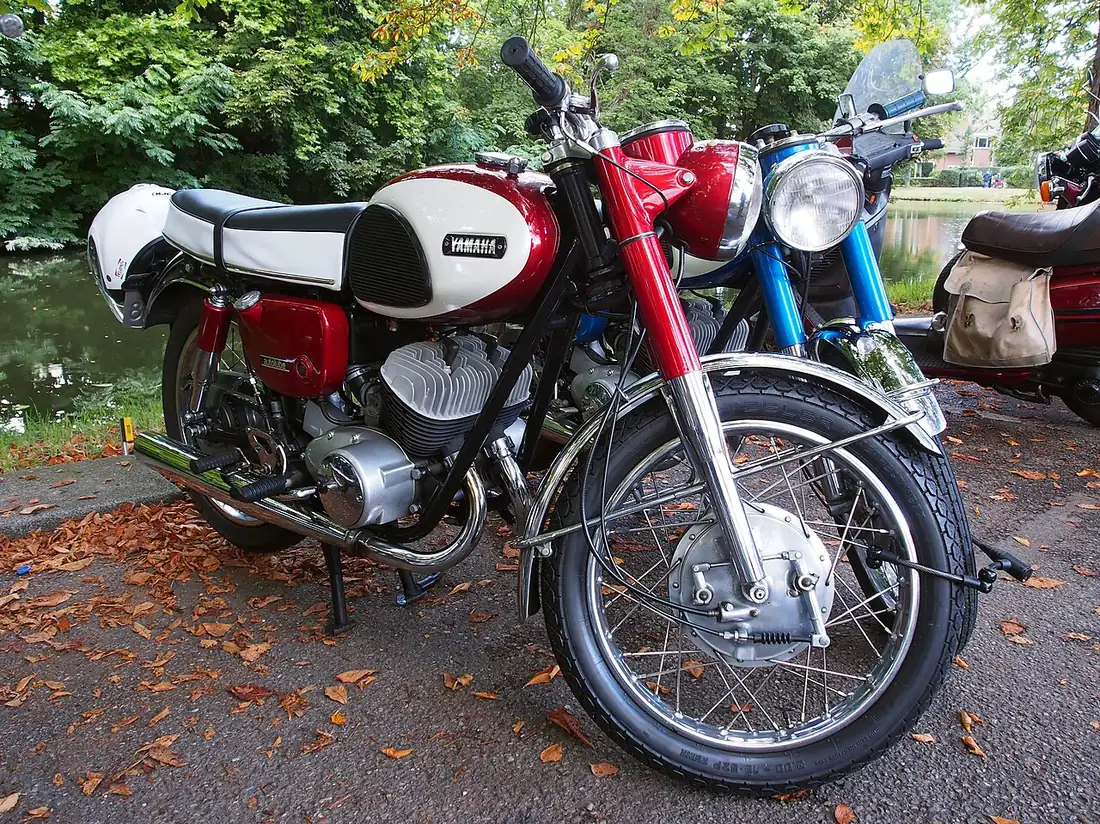
By Rahil "TorqueInductions" — my RD350 runs its Yamaha Autolube pump, serviced and set the way the manual says; my Jawa 250 runs premix because premix is all it ever had. Two bikes, two systems, one oil bill — and this page is the maths of both, done at example prices you can swap for your own.
Every two-stroke rider knows the pump ritual. You ask for five litres, then stand there with a little measuring bottle while the queue builds behind you and someone in a car starts sighing loudly. It feels cheap — it's just a splash of oil, how much can it cost? Then one day you actually do the sums, and the splash turns out to be the priciest part of your fuel. My RD350 spares me the ritual — its Autolube pump meters the oil for me — but my Jawa 250 was built for premix and still gets the bottle treatment at every fill, so I've done this arithmetic from both sides of the counter. Here it is, with the workings shown, because the workings are the part you can reuse: every price on this page is an example price, and the formula beside it is the real content. The factory figures for the bikes themselves live on the Yamaha RD specifications page; this page is about the oil.
The short answer: what a litre of petrol really carries
Pre-mix at 40:1 — a ratio with a pedigree, because it's the one Yamaha's own manuals of the era suggest for an RD twin converted to premix for competition — means 25 ml of oil in every litre of petrol. At an example price of ₹800 for a litre of two-stroke oil, that's ₹20 of oil, burned, in every single litre of fuel.
Oil injection doesn't have a number like that, and anyone who gives you one without a "suppose" in front of it is guessing. A pump's delivery changes with revs and throttle, so its average is an outcome of how you ride, not a specification. Work the example at an average of 60:1 — gentle, mixed road use — and the same litre of petrol carries about 17 ml of oil, roughly ₹13. The gap is about ₹7 a litre. Multiply by a regular rider's 30 litres a month and it's around ₹600 a month on oil with pre-mix against ₹400 with injection — roughly ₹2,400 a year. Real money. Not rebuild money. Not yet — that distinction is most of this page.
The formula and the chart: millilitres first, money second
There is exactly one piece of maths in this whole subject:
Oil in ml per litre of petrol = 1,000 ÷ the ratio. That's it. 40:1 is 1,000 ÷ 40 = 25 ml. The money is the same trick twice: cost per litre of petrol = ml × (your oil price per litre ÷ 1,000). Notice what's not in either formula: the price of petrol. Both systems burn the same petrol; only the oil differs, so only the oil price matters.
| Ratio | Oil per litre of petrol | Oil as % of the petrol | Oil cost per litre of petrol (example ₹800/L oil) |
|---|---|---|---|
| 20:1 — a pump at sustained full throttle | 50 ml | 5.0% | ₹40 |
| 25:1 | 40 ml | 4.0% | ₹32 |
| 32:1 | 31 ml | 3.1% | ₹25 |
| 40:1 — the period Yamaha premix ratio | 25 ml | 2.5% | ₹20 |
| 50:1 | 20 ml | 2.0% | ₹16 |
| 60:1 — a gentle-use injection average, as an example | 17 ml | 1.7% | ₹13 |
| 100:1 | 10 ml | 1.0% | ₹8 |
Read the first row twice, because it breaks the slogan. At sustained full throttle an oil pump feeds around 20:1 — more oil per litre than the 40:1 premix bike next to it. Injection's saving doesn't come from the top of the range; it comes from everywhere else, which is where road riding actually happens. Which brings us to what the pump is doing the rest of the time.
Why injection has no ratio: what the Autolube pump actually does
Yamaha's Autolube is a small plunger pump with two masters, and they work independently. It's driven off the crankshaft through a worm gear, so the number of strokes follows engine rpm — twice the revs, twice the strokes. And a cable from the throttle twists an adjuster plate that sets how long each stroke is, from a fraction of a millimetre at closed throttle to full stroke with the throttle wide open. Put the two together and the pump delivers roughly ten times more oil at full throttle than at closed throttle, whatever the revs are doing. On my own RD, the notebook figure from its restoration is about 1:20 at full tilt; at idle the same pump is delivering a dribble, because an idling engine barely needs oil and Yamaha knew it.
That is the entire secret of the injection saving. A premix bike carries its worst-case ratio everywhere — the 25 ml per litre that protects it at full throttle is also burned at a 40 km/h cruise and at every traffic light, where the engine needs a fraction of it. The pump spends oil like a metered utility: heavily under load, almost nothing at a standstill. It's also why "what ratio does Autolube run?" has no honest single answer. It runs all of them, in sequence, decided by your right hand.
Two small corollaries worth money. First, the pump is adjustable only where Yamaha meant it to be: the cable setting (on an RD350, the pulley mark aligns with its guide pin at idle) and the minimum-stroke shims underneath. Set it up as stock, the way the specialists who rebuild these pumps insist — a pump "turned down" by guesswork to save oil is a seizure with a savings plan. Second, injector oil and premix oil aren't fully interchangeable: pump oils are thinner so they flow through the pump and lines, and a thick premix-only oil can starve an injection system it was never made for. The cheap bottle is not always the saving it looks like.

The worked example: a month of riding, two systems
Take the regular rider from the short answer — 30 litres of petrol a month — and run both systems across the same month at the same example oil price:
| System | Oil used in 30 litres of petrol | Cost at ₹800/L (example) |
|---|---|---|
| Pre-mix at 40:1 | 750 ml | ₹600 |
| Injection, if the month averages 60:1 | 500 ml | ₹400 |
| Difference | 250 ml | ₹200 a month — ₹2,400 a year |
And because intellectual honesty is cheaper than oil: ride everywhere at full throttle and the pump's month would be 1,500 ml and ₹1,200 — the "expensive" system by a mile. Ride 15 litres a month instead of 30 and the gap halves to ₹100. The table is a shape, not a quote; your mileage and your oil price decide your numbers.
Which raises the obvious question: what's your average? You can measure it, and it takes a month of doing nothing unusual. Fill the oil tank to a level you can reproduce, write down every litre of petrol you buy, and at month's end top the oil back to the mark from a measuring jug. Your average ratio = total petrol (ml) ÷ total oil (ml). If 30,000 ml of petrol drank 500 ml of oil, your riding averages 60:1 and the table above is your table. If it drank 750 ml, you're a 40:1 rider on a pump — the pump has been matching your premix bill all along, and the difference between you and the premix man is not money at all. It's who does the measuring.
The costs that never reach the table
Because the real cost of either system was never the oil. It's the mistake — and each system keeps its mistake in a different place.
Pre-mix's mistake lives in you. Get distracted at the pump, misread the bottle, fill up in a hurry and under-oil the mix, and a two-stroke delivers its verdict the way two-strokes do: a tightening, a strange note from the exhaust, then silence and a very long walk. One bad fill can cost a piston, a bore and a crank inspection — the anatomy of that bill is the whole subject of my crankshaft rebuilding guide — and it outweighs a decade of ₹7-a-litre differences. Too much oil is gentler but not free: carbon on the piston crown and in the exhaust port, plugs that foul in traffic, a carburettor that gums up on a bike that sits, and a subtler one — premix goes stale in weeks, so oil and petrol mixed for a bike that then sits in the garage is money poured away with the old fuel. Pre-mix also smokes more and cokes exhausts faster, because it's feeding full-throttle oil at part-throttle speeds; that's a decoke schedule, which is a recurring cost wearing overalls.
Injection's mistake lives in fifty-year-old hardware — but it can be inspected. The pump has seals, the lines go brittle with age, and a pump that has quietly stopped pumping is just premix with none of the oil: the worst of both worlds, and it gives no warning at the handlebar. Owners in India who lost an engine exactly that way and now premix everything are not being irrational — they're pricing a failure they've already paid for. The counterweight is that pump failure is rarely truly silent if you look: oil lines you can eyeball, a cable setting you can check against its marks, a tank level that should fall slowly and visibly over a month's riding. A level that never falls is not economy; it's a stoppage. Keep the pump serviced, prove it after any work (owners run a little premix in the tank while a freshly primed pump earns back their trust — cheap insurance, honestly bought), and the mechanical system is the more reliable measurer of the two. One of the measurers in this comparison is a casting with a worm gear. The other is a tired human being at a fuel pump, in the rain, being hurried. Price accordingly.
