Motorcycle insurance is not optional anywhere you are likely to ride: India (Motor Vehicles Act s.146), the UK (Road Traffic Act 1988, plus continuous insurance enforcement) and every US state except New Hampshire require at least third-party liability cover. India's penalty for riding uninsured changed on 15 August 2026 — it is now three times the notified third-party base premium or ₹5,000, whichever is higher (repeat: five times or ₹10,000), replacing the old ₹2,000/₹4,000 fines and the jail term. Third-party cover is cheap because its premium is fixed by regulation (₹1,366 a year for a 150–350 cc motorcycle in India) and it protects everyone except you and your bike; comprehensive adds your own machine. The bike's value is irrelevant to the liability — the claim follows the injured person's losses, not what your motorcycle is worth.
Which RD350 clubs in India can you actually verify? The Bangalore RD350 Club, Kerala’s God’s Own Lords, RDDreams, Chennai’s documented groups — plus how to find and judge a local owners’ group.
Where rare vintage scooter parts actually turn up — the marque catalogues, the NOS shelves, the clubs and the jumbles — how the factory part number protects you, and how to spot a fake before it costs you.
Pre-mix and oil injection differ by one idea: a ratio versus a metering pump. Pre-mix at 40:1 — the ratio Yamaha's own manuals suggest when an RD-era twin is converted for competition — puts 25 ml of oil into every litre of petrol; at an example oil price of ₹800 a litre that is ₹20 of oil burned per litre of fuel. Yamaha's Autolube pump has no fixed ratio: driven from the crankshaft so it strokes with rpm, with its stroke length set by a throttle cable, it feeds about ten times more oil at full throttle than closed — roughly 20:1 at full tilt, a dribble at idle — so its average over a tank is whatever your right hand makes it. Work the example at a 60:1 average and injection burns about 17 ml, ₹13, per litre; over 30 litres a month that is ₹400 against pre-mix's ₹600, a gap of about ₹2,400 a year at the example price. The gap reverses at sustained full throttle, where the pump out-feeds 40:1 pre-mix, and it is dwarfed either way by the failure costs: a forgotten premix measure or a si
Two-strokes are not banned — new sales were. What BS6 (2020), Euro 5, London's ULEZ, Germany's H-plate, Delhi's 15-year rule and India's 50-year vintage category actually say about your classic, as of 2026.
Every Lambretta model from the 1947 Model A to the modern G350 — years, engines, power and production figures checked against marque records, plus recorded auction prices.
Recorded Rumi Formichino prices run from £1,782 (a project bike at H&H Classics, March 2026) to £6,900 (Bonhams, August 2020) — and the £6,900 bike is the same 1956 Formichino, ex-Morbidelli Museum, that Bonhams sold again in June 2025 for £4,600. Values rose through the 2010s (£2,760 in 2010, £5,980 in 2011 at Bonhams) and have sat below the 2020 peak since; the flagship Bol d'Or made £5,175 in October 2025. Dealer guides quote £7,000–13,000 for a restored Formichino, above every recorded auction result. The five-figure Moto Rumi money belongs to the racing motorcycles — Classic.com's highest recorded marque sale is a 1952 Gobbetto at $38,000 — not to the scooter.
What mint Lambrettas actually sell for — recorded H&H and Hagerty results for the SX200, GP200 and TV175, why originality beats restoration, and how far prices have fallen since the 2022 peak.
Recorded auction results for classic Vespas, Lambrettas and Heinkels — what the GS160, SX200, Rally 200 and Heinkel Tourist really made, and why condition, not the badge, sets the spread.
The "125×" figure comes from Platt et al. (Paul Scherrer Institute, Nature Communications, 2014): two-stroke scooters of 50 cc or under emitted on average 124 times more volatile organic compounds — unburned fuel vapours — at idle than other vehicle classes, per litre of fuel burned, and 11 times more over the ECE47 driving cycle. Raw exhaust at idle carried benzene at up to 300,000 µg/m³ (146 ppm). Modelled for Bangkok, the study put two-stroke scooters at around 60% of roadside primary organic aerosol on about 10% of the fuel. The figure is real but narrow — one pollutant class, one condition — and the fleet problem behind it is genuine.
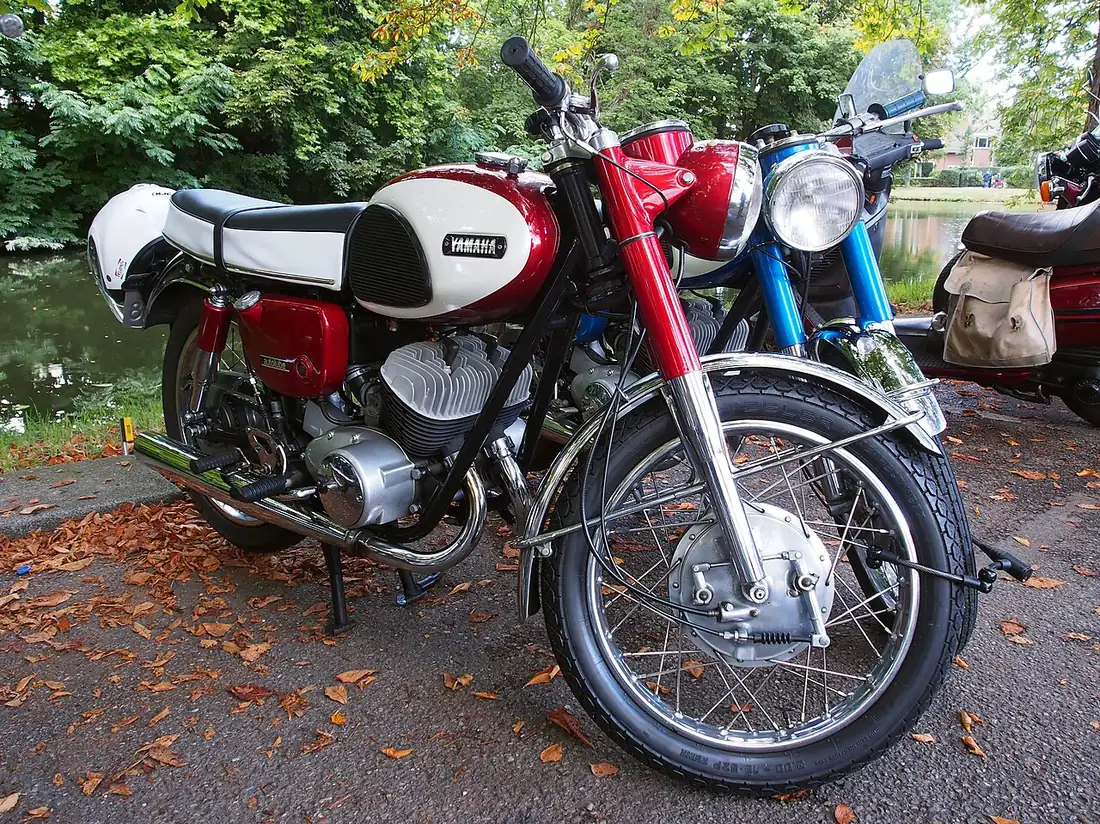
On a Yamaha, RD is most widely read as "Race Developed" — the name given to Yamaha's two-stroke sports twins when the range launched in 1973 with the RD250 and RD350. The reading is genuinely contested: Yamaha's own model codes suggest RD may simply be a factory designation (R for road, D for two-stroke, the same pattern as DT and XS), with "Race Developed" popularised later by UK marketing, and some Indian sources print "Race Derived" instead. What is not contested is the hardware: reed-valve two-stroke twins derived from Yamaha's production racers, spanning the 124 cc RD125 twin to the 499 cc RD500LC V4, and built in India by Escorts from 1983 as the Rajdoot 350.
Should you convert a classic motorcycle to electric? What conversions really involve, what Electrogenic, Beachman and the eCUB kit charge, why reversible is the only sane way — and why India currently has no legal route for an RD350.