By Rahil "TorqueInductions" — full disclosure first: I have never owned an H1. My two-stroke life is RD350s, an RX100 and a Jawa 250, and this page is a historian's piece, not an owner's diary — every figure is sourced in my research notes, and where period testers disagreed with Kawasaki's claims, I have printed both. The RD connection is real, though: the H1 is the bike that proved a light, cheap two-stroke could humiliate bigger machines, and the RD350 is what happened when that idea grew up and learned some manners. More about me →
The Kawasaki H1 Mach III is a 498 cc two-stroke triple that Kawasaki launched in 1969 with a claimed 60 horsepower, a $995 price tag and the fastest acceleration of any production motorcycle in the world. It is the original "Mach 3" — the bike the queries are about — and it earned its fame twice over: once for what the engine did, and once for what the chassis couldn't.
| Engine | 498 cc air-cooled two-stroke inline triple, piston-port, 60.0 × 58.8 mm |
| Claimed power | 60 hp @ 7,500 rpm |
| Claimed torque | 56 Nm (42 lb-ft) @ 7,000 rpm |
| Carburettors | 3 × Mikuni VM28 |
| Ignition | Capacitor discharge (CDI) via distributor — a production-bike first |
| Gearbox | 5-speed, neutral at the bottom, all five up |
| Weight | 174 kg (382 lb) dry |
| Production | H1–H1F 1969–1975; renamed KH500 1976 |
| Price at launch (US) | $995 |
Everything else about the Mach III — the drag-strip legend, the "Widowmaker" nickname, the eight-year slide from wild to tame — follows from the decision Kawasaki made in a secret planning room in 1967: build the quickest-accelerating motorcycle on earth, and let the rest of the bike catch up later. It never quite did, which is exactly why we are still talking about it.
Born in secret: the N100 plan
In the mid-1960s Kawasaki was a giant in heavy industry that nobody in motorcycling took seriously — its W1 650 twin had been intended to crack the American market and hadn't. So in July 1967 the company started a top-secret project, codenamed N100, with targets that sounded like a misprint: from 500 cc, extract 60 horsepower — 120 hp per litre, racing-bike specific output — and cover the standing quarter-mile in 13 seconds, at a time when 13 seconds was considered beyond any road bike.
Honda was known to be preparing a big four-cylinder flagship (the CB750, which would appear within weeks of the H1), but Kawasaki's answer was deliberately different: not bigger, not smoother — lighter, cheaper and violently quicker off the line. The first production Mach III came off the line in September 1968, fourteen months after the N100 plan began, and went on sale in Japan as the 500SS Mach III and in America as the H1 Mach III for the 1969 season. In the end Kawasaki built more than 110,000 of the 500 triples across the model's life.
The claims, and what the testers actually measured
Kawasaki launched the H1 claiming 124 mph and a 12.4-second standing quarter — the British press quoted the figures back with raised eyebrows, as Kawasaki's "own ambitious claim" for "the fastest and best accelerating road machine ever produced". The measured truth was a little short of the poster and still astonishing for a 500: Cycle World's 1969 test recorded 119.14 mph and 13.20 seconds. Other period tests landed in the same neighbourhood — 109 mph and 13.5 seconds from Reads of London, a 13.48-second quarter credited to Dutch drag racer Henk Vink.
To make the point where it mattered, Kawasaki sent its own test rider, Tony Nicosia, touring American drag strips on a production H1 to demonstrate the numbers in public. The conclusion the American press reached — that the Mach III was the fastest mass-production motorcycle available in the USA at the time — stood even as Honda's CB750 collected the "bike of the year" headlines. Motorcyclist put the H1's distinction precisely: its power-to-weight ratio was the best "ever produced in a motorcycle meant to sell to anyone who has the money to purchase it". And it did all this for $995, in a market where an average 750 cost around $1,400 and Triumph's three-cylinder Trident — slower to the quarter — cost $1,795.

The engine: three cylinders, electronic ignition, no manners
The motor itself was a clean-sheet design that shared nothing with Kawasaki's other bikes: three cylinders across the frame, tilted forward 15 degrees, breathing through piston ports and one 28 mm Mikuni per cylinder, with Kawasaki's Injectolube oil injection metering two-stroke oil from a separate tank. The radical part was electrical. The H1 was the first production street motorcycle with capacitor discharge ignition, and the first multi-cylinder street bike to use it — a thyristor CDI unit making a claimed 25,000–30,000 volts, distributed to the three plugs by what was essentially a small car distributor. Ordinary spark plugs would not survive that voltage, so the first bikes ran surface-gap plugs borrowed from American outboard motors. The strong spark had a genuine virtue: it all but eliminated the plug fouling that plagued lesser two-strokes.
Character-wise, period accounts agree on the shape of it: not much below, then the power arriving at about 6,000 rpm in one step. The engine was bolted solidly into the frame — the rubber-mounted prototype had produced odd harmonics, so production bikes went without — and Hagerty's modern assessment notes that the vibration "could numb your fingers", while the small tank gave a range of roughly 80 miles. One more quirk every H1 shares: the gearbox pattern is neutral at the very bottom, then five lifts up. Miss that detail on your first ride and you will find neutral exactly when you least want it.
The engine was serious enough to race. Kawasaki's H1R derivative put Ginger Molloy second to Giacomo Agostini in the 1970 500 cc world championship, and in 1971 Dave Simmonds won the Spanish Grand Prix at Jarama on an H1R — Kawasaki's first victory in the premier class. A standard H1 even won the 500 cc Production class at the 1974 Isle of Man TT, ridden by Keith Martin. Whatever else was wrong with the Mach III, it was never the motor.
The reputation: the triple with the ripple
Now the other half of the legend, because the H1's notoriety was earned as honestly as its speed. The chassis was a collection of compromises: a frame of small-diameter tubes that Hagerty calls "fairly weak", a swingarm pivot built to indifferent tolerances, forks and rear shocks borrowed from much smaller bikes (the shocks came from the 250 Samurai), and 57 per cent of the bike's weight sitting over the rear wheel. Kawasaki had set the engine well back in the frame — partly, Classic Bike Guide explains, to get cooling air to the hard-working middle cylinder — and the steering geometry paid for it.
The period verdicts were not kind. Hagerty summarises the riding experience as drum brakes that were "less than exemplary" and a tendency, accelerating through a corner, to generate a tank-slapper. MCNews's much-quoted judgement was that "the brakes very questionable and the handling decidedly marginal in every situation — except when the bike was stopped with the engine switched off", adding: "Not for nothing was the H1 known as, 'The triple with the ripple'." Add a powerband that arrived like a switch at 6,000 rpm — on 1969 tyres, through that frame — and you have the recipe that attached the "Widowmaker" nickname to Kawasaki's triples. Kawasaki's own model-year changes read like a quiet confession: a disc brake and a steering damper for 1972, the engine shuffled in the frame, the power spread wider with each revision.
None of this made the H1 a bad motorcycle so much as an unfinished one — a dragster sold as a road bike, at a price that put it in the hands of riders who had no business on it. That is precisely the combination that builds a legend.
The variants: H1 to KH500, 1969–1976
The Mach III's eight years are a steady trade of wildness for civility. The changes that actually matter, year by year:
| 1969 — H1 | The original: distributor CDI (US bikes), twin-leading-shoe front drum, sculpted "knee-recess" tank, Midnight White |
| 1970 — H1 | New colours (Peacock Grey, Candy Red). British and European bikes used points ignition — the CDI's radio interference had drawn official objections |
| 1971 — H1A | New fuel tank without the knee scallops; Candy Blue |
| 1972 — H1B | Points ignition replaces the CDI; front disc brake; steering damper added; Pearl Candy Orange. (The rare H1C, North America only, was a drum-brake special built from leftover parts) |
| 1973 — H1D | CDI returns, using the H2 750's unit — a hotter low-rev spark allowed re-jetting for a wider power band; race-style tail; steering damper dropped; Candy Green |
| 1974 — H1E | Revised CDI; crankcase check valve added |
| 1975 — H1F | Colours and trim only — the last H1 |
| 1976 — KH500 | Renamed in Kawasaki's range-wide rebrand: emissions jetting cuts power to 52 hp, conventional 1-down/4-up gearchange, KZ900-type front disc, rubber-mounted engine, 192 kg dry |
Read the table as a graph and the story tells itself: every year the bike got a little heavier, a little calmer and a little easier to live with, until the KH500 — which Cycle World's 1976 buyers guide called "much more refined… quite a nice touring machine" while noting it was "still… one of the quickest machines on surface streets" — closed the line. The two-stroke triple idea did not die because it failed; it was legislated and out-refined out of existence, and Kawasaki's own 750 H2 (the Mach IV) carried the same arc one size up. I have put the H1 in its wider family — H2, Suzuki's GT750, the RG250 and the TZ750 and NSR250R racers — in my history of golden-era two-stroke motorcycles.
What goes wrong, and what to check before you buy
Half a century on, an H1 is a collector's bike, and the checks that matter are the ones that separate an honest survivor from an expensive story:
- Start with the ignition — and know which one you're looking at. The 1969–71 distributor CDI was complex and unreliable even when new, its distributor bearing a known weak point; the 1972 points system is simple; the 1973-on CDI is the sorted one. A misfiring early bike is an ignition suspect first. A bike's ignition type also tells you which model you're really buying.
- Check for accident damage, and buy the provenance. Hagerty's collector guidance is blunt: the handling was unforgiving, survivors are not numerous, and the frame was never strong. Look hard at steering stops, frame rails and fork alignment, and pay for documented history over shiny paint.
- Compression, evenly, across all three. Crankshaft seals harden and leak with age on any old two-stroke triple, and the middle cylinder lived the hottest life. Uneven compression, scored bores or damaged fins mean engine money — budget for it or walk.
- The oil pump is not optional. The Injectolube pump, its lines and check valves must be present and working. A bike that has sat for years with a seized or disconnected pump will seize properly the first time you ride it in anger. Verify the pump before the first start, not after.
- Exhausts and odd parts. Three separate silencers on the early bikes rot from the inside and are expensive to replace; Hagerty notes that some H1 parts are simply hard to find now. A complete, correct bike is worth more than a prettier incomplete one.
- Verify the identity. Frame numbers are stamped on the steering head: KAF- prefix for the H1 to H1C, changing to H1F- from the H1D — two years before the H1F model existed, which catches people out. Engine numbers are KAE- throughout. Cross-check both against the published ranges before paying first-year money for a bike, and remember the shift-pattern tell: every true H1 changes all-up from a bottom neutral; a "1975 H1" that shifts 1-down/4-up is a KH500 in disguise.
Already own one? The spanner work lives in the maintenance guide
This page is the overview; the workshop companion already exists on this site. My Kawasaki H1 Mach III maintenance guide covers the ownership routine in depth — ignition by model year (including the points conversion and why British bikes were different), carburettor and oil-pump setup, crank-seal symptoms, the all-up gearbox explained, and the model-year table for identifying exactly what is in your garage. If you keep a paper manual on the bench as well, the Yamaha service and repair handbook that also covers the H1 is the period workshop reference listed in the shop.
The H1 Mach III is not the best motorcycle of 1969, and on the evidence of its own era it was not trying to be. It was the quickest — full stop — and it sold that single, glorious talent for $995 to anyone who walked into a showroom. My RD350, arriving four years later, is the same idea with the edges rounded off: still a light two-stroke that punches above its weight, but one you can ride home in the rain. The Mach III never learned that trick. That is not its failure. That is its legend.
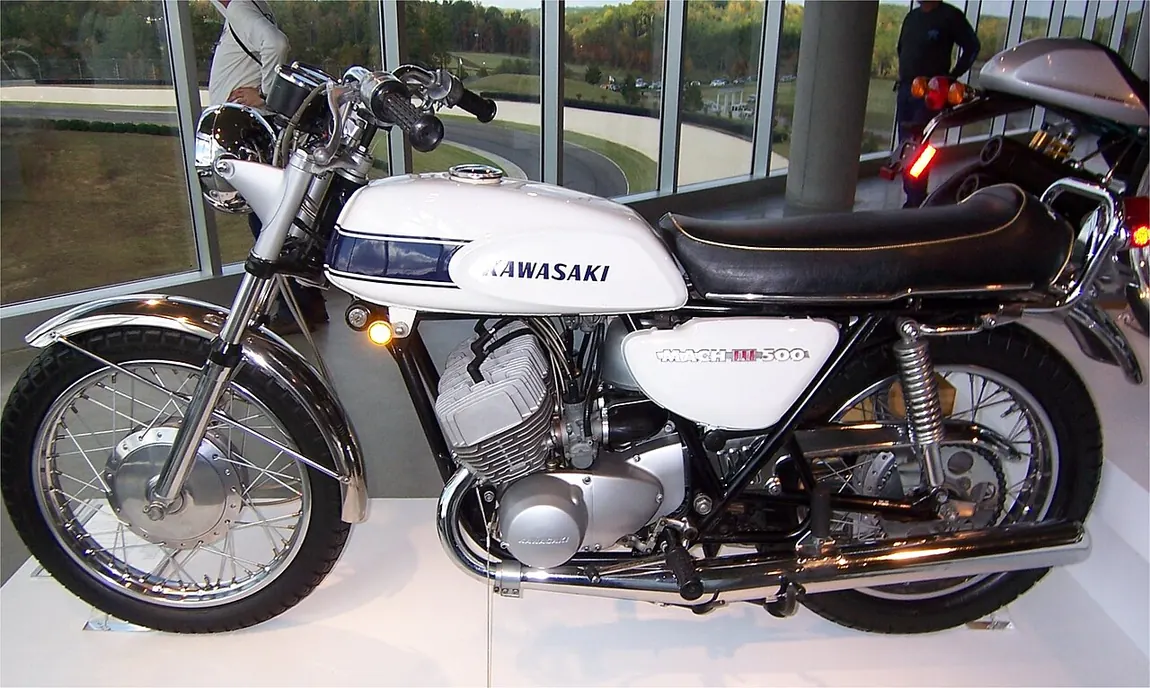
Photo: a 1969 Kawasaki H1 Mach III at the Barber Vintage Motorsports Museum — the first-year bike, drum brake, scalloped tank and all. Photo by Mike Schinkel (retouched derivative by Ligabo), CC BY 2.0, via Wikimedia Commons.
Questions owners ask me
What is a Kawasaki H1 Mach III?
It is Kawasaki's 500-class two-stroke triple of 1969–1975 — a 498 cc air-cooled inline three making a claimed 60 hp, sold in the US at $995 and renamed KH500 for its final year, 1976. "Mach III" was the model's name (Mach IV was the 750 H2), and "Mach 3" is the same bike under its common shorthand. At launch it was the fastest-accelerating production motorcycle in the world.
How fast is the Kawasaki Mach 3?
Kawasaki claimed 124 mph and a 12.4-second standing quarter-mile. Period testers measured slightly less and still called it extraordinary for a 500: Cycle World recorded 119.14 mph and 13.20 seconds in 1969, with other period tests between 109 and 119 mph and quarter-miles in the low 13s. Kawasaki's own rider Tony Nicosia toured US drag strips on a production bike to prove the claims had substance.
Why is the Kawasaki H1 called the Widowmaker?
Because of the gap between its engine and its chassis. The power arrived abruptly at about 6,000 rpm, 57 per cent of the weight sat over the rear wheel, the frame was lightly built, and the early bikes stopped with a drum brake — a combination that produced tank-slappers and a fearsome reputation in period tests, one of which nicknamed it "the triple with the ripple". The Widowmaker tag attached itself to Kawasaki's triples generally, the H1 first among them.
What is the difference between the Kawasaki H1 and the KH500?
They are the same motorcycle line at different ages. The KH500 (1976) is the H1 renamed in Kawasaki's range-wide rebrand, and detuned for emissions: 52 hp against the early bike's 60, a conventional 1-down/4-up gearchange instead of the H1's all-up pattern, a rubber-mounted engine, a KZ900-type front disc and 192 kg dry against 174 kg. Think of the KH as the H1 after seven years of finishing school.
What is the difference between the Mach III and the Mach IV?
Size. The Mach III is the 500 — the H1, 498 cc, 60 hp. The Mach IV is its bigger brother, the 750 H2 of 1972: 748 cc and 74 hp, with the same triple layout, the same abrupt power and an even stronger version of the same reputation. If a photograph shows a front disc brake and a visibly larger engine, you are looking at the 750, not the 500.
What should I check when buying a Kawasaki H1?
Five things, in order: the ignition system (the 1969–71 distributor CDI is the fragile one — know which system the bike has); accident damage and documented provenance, because the frames were lightly built and the handling unforgiving; even compression across all three cylinders, with the middle pot the heat-stressed one; the Injectolube oil pump and its lines, which must be present and working before the first start; and the numbers — KAF- frame prefix up to the H1C, H1F- from the H1D, KAE- engine prefix throughout — cross-checked against the published ranges.