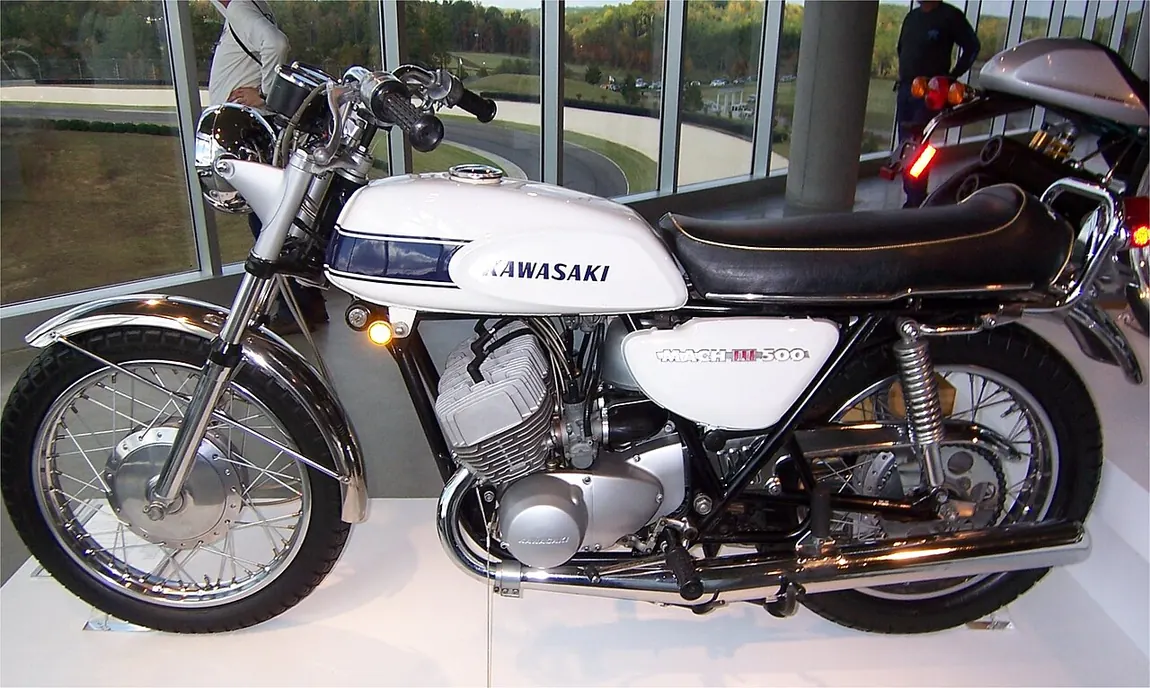
By Rahil "TorqueInductions" — full disclosure first: I have never owned an H1. My two-stroke life is RD350s, an RX100 and a Jawa 250, and this page is a historian's piece, not an…
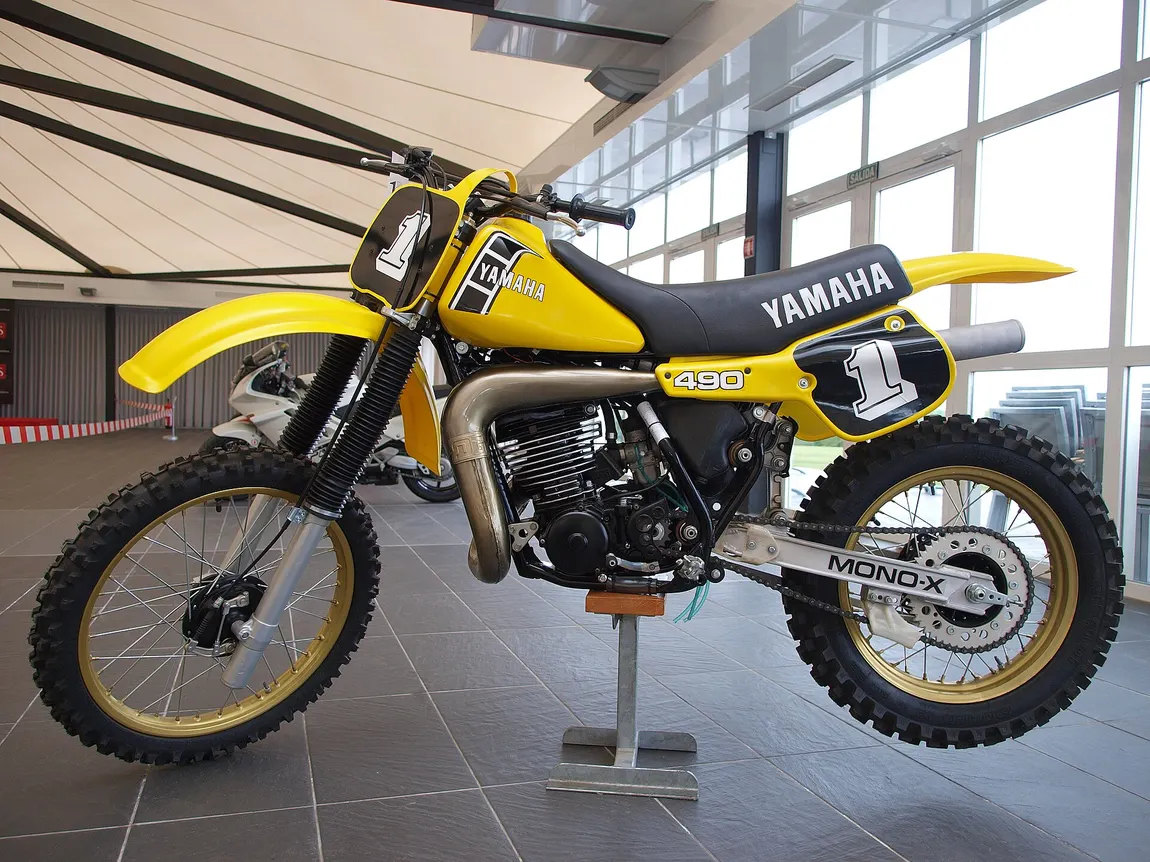
By Rahil "TorqueInductions" — full disclosure first: I have never owned a YZ490. My two-strokes are road bikes — RD350s and an RX100 — so this page sti…
How micro-perforated mufflers silence a two-stroke with no wool to burn out — hole size, porosity, cavity tuning and pressure drop, the one SAE motorcycle silencer that used them, and what the stinger has to say about it.
Turbocharging a Yamaha RD350 is physically possible but fights the engine's operating principle. A crankcase-scavenged two-stroke breathes by pressure difference: the descending piston pressurises the crankcase and pushes fresh charge through the transfer ports while the exhaust port is still open, and the expansion chamber's returning pressure wave stuffs escaping charge back in — the effect Gordon Jennings called the two-stroke's built-in supercharging. A turbocharger disturbs both halves of that system: its turbine restricts the exhaust and raises back pressure against scavenging, and pressurised intake charge can short-circuit straight out of the open exhaust port. Every factory turbo motorcycle of the 1980s (Honda CX500 Turbo, Yamaha XJ650 Turbo, Suzuki XN85, Kawasaki GPz750 Turbo) was a four-stroke. The only factory turbocharged two-stroke, Rotax's 850 E-TEC Turbo snowmobile engine of 2020, was designed around its turbo from the start, uses direct injection and an ECU-controlled
How expansion chambers work on Lambretta and Vespa scooters, the pipes that actually exist — JL, Franspeed, PM Tuning, SIP Road, clubmans — plus jetting, noise and the MOT, with the invented power claims removed.
There is no bolt-on kit — and no documented build, anywhere — for putting a transverse motorcycle twin (Moto Guzzi V50, Honda CX500 or any other) into a classic Vespa or Lambretta. The architecture forbids the easy version: on a classic scooter the engine is the rear suspension and driveline in one unit, and the Guzzi's longitudinal crank and shaft drive cannot be spliced to it with a welded clutch centre. The twin-cylinder scooters that genuinely exist are two-stroke conversions of the scooter's own engine: Scooter the Fero's Chimera kit (€4,460 plus €720–€1,160 of exhausts; about 450 cc and roughly 50 bhp with twin TS1 top ends; sold, in its maker's own words, for sporting use only) and Germany's Lutz twin (a patented one-piece twin crankshaft on standard casings; 106.4 PS on a nitrous dyno run; street versions around 60 bhp). In India, section 52 of the Motor Vehicles Act leaves no routine route to endorse a different engine in a vintage scooter; in the UK an engine change needs DVL
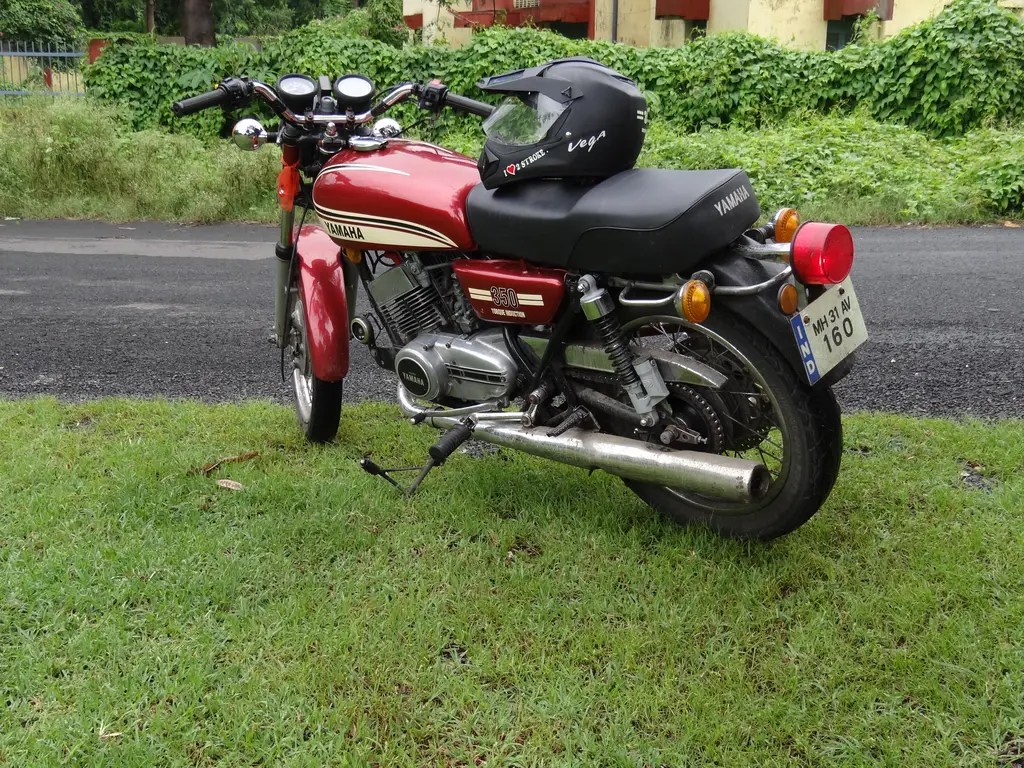
A stock air-cooled Yamaha RD350 (1973–75) made 39 hp at the crank (about 32 hp at the rear wheel) and was quoted at 105 mph, but period magazine instruments measured two-way top speeds of 102.6–103.8 mph, quarter miles between 14.12 seconds (Cycle magazine, the best) and 14.75 seconds, and 0–60 mph in about 5.2 seconds — not the 130 mph and 4.8 seconds of bar talk. The RD350LC made 47 hp (factory) and averaged 107.1 mph two-way at MIRA with a 13.82-second quarter; the YPVS made 59 hp (factory) and its US RZ350 version ran 13.19 seconds in period testing; India's Rajdoot 350 HT made 30.5 bhp (factory) and was commonly cited at under 7 seconds to 100 km/h in period Indian tests.
The Suzuki RG250 Gamma (1983–87) was the first mass-produced motorcycle with an aluminium frame — Suzuki's square-pipe double-cradle ALBOX, announced at 7.3 kg in improved 1984 MR form. This guide covers what the frame actually is, how Mk1–Mk4 differ, what AEC does, the Walter Wolf special, and the frame checks that matter when buying one today.
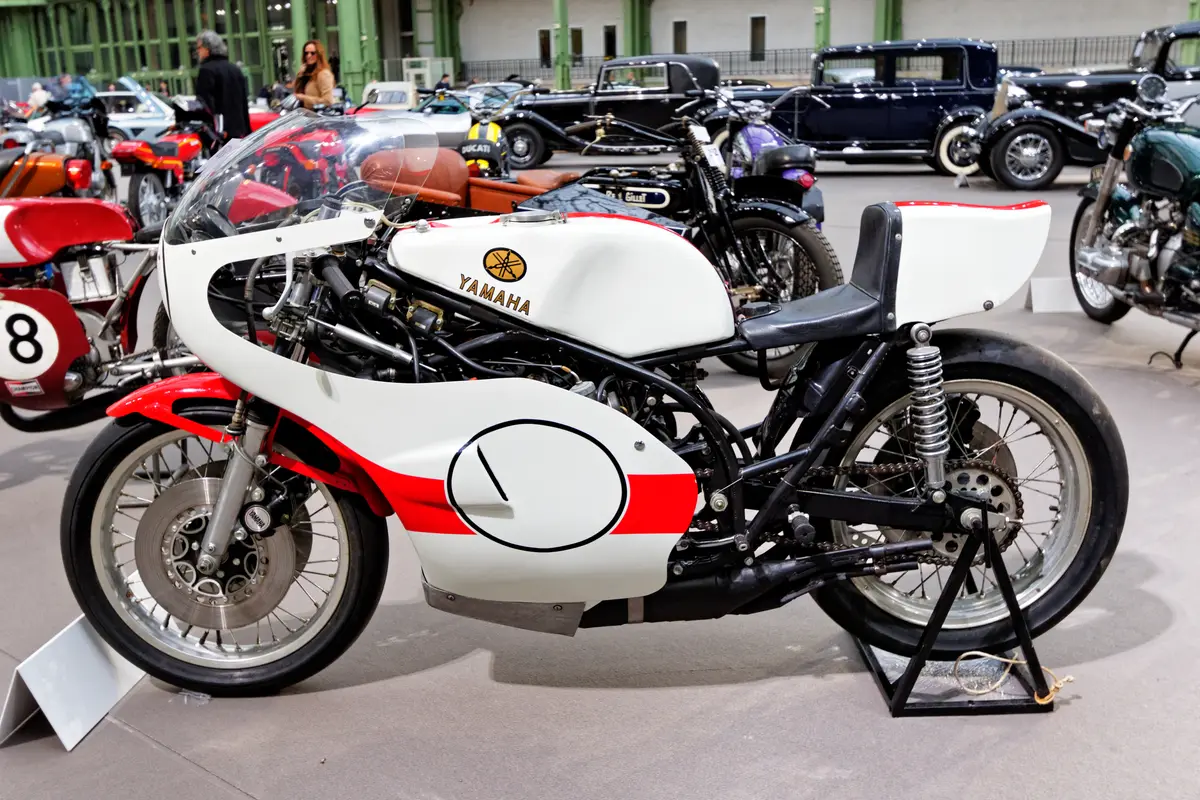
The Yamaha TZ750 is a series-production two-stroke racing motorcycle built from 1974 to 1979 for Formula 750. Its liquid-cooled inline-four used two 180-degree crankshafts set end to end in a common crankcase, coupled by centre gears to a jackshaft — an arrangement that made the cranks rotate backwards. The 1974 original displaced 694 cc (64 × 54 mm, the RD350's dimensions) and was rated at 90 PS; the full 747 cc version (66.4 × 54 mm) arrived with the B, and the monoshock 1977 D was rated at 120 PS. Only 567 were built. TZ750s won the Daytona 200 nine years running, 1974–82 (Agostini, Romero, Cecotto, Baker, Roberts, Singleton, Pons, Singleton, Crosby), and took the Formula 750 world title in 1977 (Steve Baker), 1978 (Johnny Cecotto) and 1979 (Patrick Pons). In 1975 Kenny Roberts won the Indy Mile dirt-track race on a TZ750-engined flat tracker built by his tuner Kel Carruthers; the AMA banned the engine from dirt track, and Roberts' verdict — "They don't pay me enough to ride that th
Torque is twisting force: a force multiplied by the length of the lever it acts through (τ = F × r), measured in newton-metres (N·m) or pound-feet (lb-ft) — 50 N on a 20 cm spanner is 10 N·m. Horsepower is not a rival quantity but torque put to work at speed: hp = torque (lb-ft) × rpm ÷ 5,252, which is why torque and horsepower curves plotted on the same scale always cross at 5,252 rpm (in metric units, kW = N·m × rpm ÷ 9,549). Gearing multiplies torque at the rear wheel — a 39-tooth rear sprocket swapped for a 42-tooth gives 7.7% more wheel torque and 7.1% less road speed per gear. A US-spec RD350B's factory figure is 39 bhp at 7,500 rpm (rd350.info/specifications), which means it is making 27.3 lb-ft (37.0 N·m) at that speed; the Indian High Torque version's period-quoted peak was 3.3 kg·m (32.3 N·m) at 6,500 rpm.
The Harley-Davidson RR350: Aermacchi's 347cc Grand Prix twin and Walter Villa's 1976 350cc world title — verified specs, the honest season-by-season record, and how many were really built.
The Yamaha RD500LC (1984–1986) was Yamaha's road-going replica of its YZR500 Grand Prix racer: a 499 cc, 50-degree, twin-crankshaft V4 two-stroke with YPVS power valves, for which Yamaha claimed 88 hp at 9,500 rpm (factory). It weighed 205 kg dry (factory), and MCN's first road test recorded 148 mph on the test strip (period test). It was sold as the RZ500 in Canada and Australia, never officially sold in the USA because of EPA emissions rules, and Japan got the RZV500R — a limited run of 1,600 units with a hand-welded aluminium frame and the engine detuned to 64 hp for Japanese law. Production ended in 1986.