By Rahil "TorqueInductions" — full disclosure first: I have never owned a YZ490. My two-strokes are road bikes — RD350s and an RX100 — so this page sticks to what can actually be shown: factory figures labelled as factory, period magazine reporting labelled as period reporting, and an honest blank where Yamaha never published a number. It is the year-by-year companion to my main YZ490 post, which tells the bike's story; this page is the spec sheet that story never had room for.
The Yamaha YZ490 was built for nine model years, 1982 to 1990 — there is no 1981 YZ490, whatever the search suggestions imply; 1981 was the last year of the YZ465 it replaced. Every YZ490 uses the same basic engine: a 487 cc air-cooled two-stroke single, 87 × 82 mm, reed-valve induction with Yamaha's YEIS boost bottle. What changed across the run was everything around that engine — the carburettor grew in 1984, a front disc brake finally arrived in 1985, a fifth gear and a new frame landed in 1986, and cartridge forks turned up in 1988. Claimed power depends on the year and on who is claiming: a period dyno measured 44.7 hp at the rear wheel in 1983, Yamaha's own 1987 brochure claims 61 PS (DIN), and Hagerty's valuation data lists 55 hp for 1985 and 47 hp for 1987–90. Top speed was never published at all; the commonly quoted estimate is 85–88 mph, and it is the gearing, not the power, that runs out first. The full table is below — one row per year, every figure labelled with its source.
| Year |
Model code |
Gearbox |
Front brake |
Claimed power |
Weight |
Headline change |
| 1982 |
YZ490J (5X6) |
4-speed |
Drum |
Not published |
Not reliably published |
Launch: 487 cc engine replaces the YZ465 |
| 1983 |
YZ490K (23X) |
4-speed |
Drum |
44.7 hp at the rear wheel, measured* |
Not reliably published |
Detail changes; Glover wins the AMA 500 title |
| 1984 |
YZ490L (40T) |
4-speed |
Drum |
Not published |
Not reliably published |
Eight-petal reeds, radial head, centre-exit exhaust, new frame, 40 mm carb |
| 1985 |
YZ490N (57H) |
4-speed |
Disc, 220 mm |
55 hp (Hagerty) |
223 lb shipping (Hagerty) |
Front disc at last; one-year BASS experiment; Glover's title year |
| 1986 |
YZ490S (1LV) |
5-speed |
Disc, 220 mm |
Not separately listed |
223 lb shipping (Hagerty) |
New frame, linkage under the swingarm, fifth gear |
| 1987 |
YZ490T (2HJ) |
5-speed |
Disc, 220 mm |
61 PS DIN @ 7,000 rpm (factory brochure)† |
102.5 kg dry (factory brochure) |
Re-ported cylinder and head work, chasing the jetting |
| 1988 |
YZ490U (2HJ) |
5-speed |
Disc, 230 mm |
47 hp (Hagerty) |
225 lb shipping (Hagerty) |
Cartridge forks; bigger front disc |
| 1989 |
YZ490W (2HJ) |
5-speed |
Disc, 230 mm |
47 hp (Hagerty) |
225 lb shipping (Hagerty) |
Price rise and detail changes |
| 1990 |
YZ490A1 (2HJ) |
5-speed |
Disc, 230 mm |
47 hp (Hagerty) |
225 lb shipping (Hagerty) |
Final year; carry-over |
* The 1983 figure is a measurement, not a claim: Cycle Guide magazine's May 1983 open-class dyno test, at the rear wheel. It reads lower than brochure numbers because rear-wheel measurements always do.
† US sources quote the 1987 bike lower — spec aggregators say 55 PS and 107 kg dry, Hagerty lists 47 hp. The factory brochure figure is used here because it is the only primary source; the spread is discussed in the 1987 section below.
One warning before you quote any of this elsewhere: Yamaha USA did not publish horsepower for the YZ490 in most years, so the power column mixes three different kinds of figure — factory claims, one period dyno measurement, and Hagerty's valuation-guide data — each labelled. Where no source we trust publishes a number, the cell says so rather than borrowing one from a spec-aggregator site.
Jump to your year: 1982 · 1983 · 1984 · 1985 · 1986 · 1987 · 1988 · 1989 · 1990 · Top speed · YZ490 vs IT490

1982 — the launch year
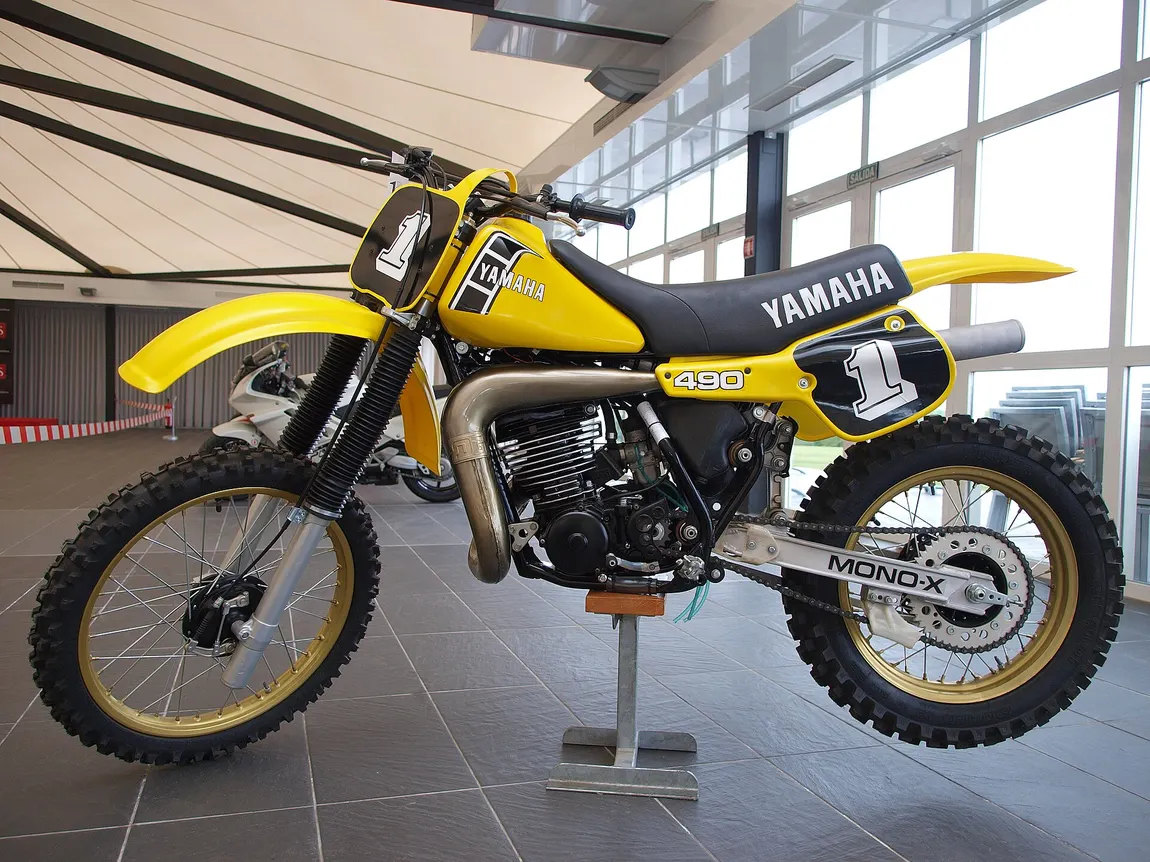
The first YZ490 put the new 487 cc engine — up from the 465's capacity, and the biggest single Yamaha had ever sold — into a chassis closely related to the YZ465's, with a four-speed gearbox, drum brakes at both ends, a 38 mm Mikuni carburettor and the Monocross single-shock rear end. Period testers found it heavier and harder-edged than the well-liked 465 it replaced: more power, delivered more abruptly, in a bike that asked more of its rider. Yamaha published no power figure for it, and no weight figure from a source worth trusting has survived — which is why this row of the table is blank rather than borrowed. The bike in the photograph at the top of this page is an early, drum-brake model in the yellow US competition colours.
1983 — few changes, the best dyno evidence
Yamaha left the 490 much as it was for 1983, and the year is remembered for racing instead: Broc Glover won the AMA 500cc National Championship on the YZ490, his second of three 500-class crowns. It is also the year that gives us the single most trustworthy power figure for any YZ490. Cycle Guide magazine's May 1983 open-class comparison put the bikes on a dyno, and the YZ490 recorded about 44.7 hp at 8,500 rpm at the rear wheel — the strongest of the four tested, ahead of the Maico 490 Spider (43.8), the KTM MC495 (41.7) and the Suzuki RM500 (41.3). Treat that as the honest anchor for the whole model's output: everything higher on this page is a crankshaft claim measured under someone's favourable standard. 1983 is also the year the enduro version appeared — the IT490, covered in the comparison section below.
1984 — the big update
If you are choosing one early year, this is the interesting one. Cycle World called the 1984 bike "truly new", and for once the phrase was earned: a revised cylinder with an eight-petal reed cage in place of the earlier six-petal unit, a radial cylinder head, a centre-exit exhaust port, a new frame with a wishbone-style front downtube, Z-spoke wheels, and the carburettor up from 38 to 40 mm. The engine work was aimed squarely at the standard complaint — power that arrived like a light switch — by broadening the delivery. The same year, Yamaha shut down its works-bike programme and went racing on production-based machinery, which made the production bike's specification a competition matter rather than a brochure one. What the update did not touch: the four-speed gearbox and the drum brakes at both ends, the two complaints that would run for two more years.
1985 — a front disc, and Glover's year
The front drum finally went. The 1985 bike brakes with a 220 mm front disc (the rear stayed a drum, as it would to the end of production), and the US model wore gold Takasago rims and white bodywork with red and blue graphics. It also carried a one-year experiment: BASS, the Brake Actuated Suspension System, a cable linking the rear brake pedal to the rear shock's compression damper so that braking would firm the rear end against jacking. Most riders disconnected it, and it is remembered now mainly as a curiosity. Hagerty's data lists the 1985 bike at 55 hp claimed, a 223 lb shipping weight and a $2,599 list price. The racing headline outshines all of it: Broc Glover won the 1985 AMA 500cc National Championship on a production-based YZ490 — a works five-speed gearbox and a ported cylinder head about the only exotica on it — against David Bailey's full-factory Honda RC500. It remains the model's defining achievement, and it is told in full in the main YZ490 post.
1986 — the redesign
The last major redesign, and the one that defines the later bikes. A new frame — stronger, gusseted tubing — with the Monocross linkage repositioned below the swingarm, which dropped the shock's mounting and the bike's centre of gravity; slimmer seat, tank and side panels, with the tank holding 0.4 gallons more than the 1985 bike's; and, at last, a fifth gear, with the ratios tightened up to use it. The 43 mm Kayaba forks stayed conventional damper-rod units but with all-new internals, and the rear shock was a new Showa-built unit in the Öhlins style. The engine, pointedly, was essentially untouched — and the carburettor jetting, the complaint that followed this model from its first year, was still off. Hagerty lists a 223 lb shipping weight and a $2,649 price; no separate power claim for 1986 survives in a source worth citing, so the table leaves it blank.
1987 — chasing the jetting
A detail year with an honourable purpose: Yamaha massaged the cylinder head and re-ported the cylinder in another attempt to fix the fuelling and the detonation the model was notorious for — the pinging that owners still cure today with the squish-band modification covered elsewhere on this site. The 1987 bike is also the one year for which Yamaha printed a complete factory specification, in its UK brochure: 61.0 PS (DIN) at 7,000 rpm, 66.4 Nm of torque at 6,000 rpm, a 102.5 kg dry weight, a 10-litre tank, a Mikuni VM40SS carburettor, and a 6.94:1 compression ratio. American sources quote the same bike lower — aggregators say 55 PS and 107 kg, Hagerty lists 47 hp — and that spread is worth understanding rather than averaging away: a DIN crankshaft figure from a European brochure and the conservative numbers US references settled on are measuring different things in different ways. On the track, Jeff Stanton finished second in the AMA 500 National standings on the 490 — the model's last front-line result.
1988 — forks and brakes, finally sorted
The year the front end caught up with the engine. The damper-rod forks were replaced by 43 mm Kayaba cartridge forks — the change period testers had been asking for since 1982 — and the front disc grew from 220 to 230 mm. Little else moved: Cycle News' model-year preview called the 490 "the least changed of all the YZs" and listed the fork as effectively the only difference, which by 1988 read as praise for the fork and criticism of everything else. Hagerty lists 47 hp, a 225 lb shipping weight and a $2,999 price.
1989 — a price rise and little else
Detail changes and a substantial price rise — Hagerty's figures go from $2,999 to $3,549, with power still listed at 47 hp and shipping weight at 225 lb. By 1989 the open class had moved on around the Yamaha: water cooling, power valves and detachable rear subframes were the class standard, and the air-cooled 490 was selling on simplicity, price and the loyalty of riders who liked a big two-stroke that could be serviced with hand tools. Nothing about that pitch was dishonest. It just wasn't a development programme.
1990 — the final year
The last YZ490 was a carry-over bike, and the class had left it behind in ways that were now structural: by 1990 it was the only machine in the 500 class without a detachable rear subframe, and PulpMX's retrospective on the model sums the late bikes up as a design left to languish with minor updates for half a decade. Hagerty lists the same 47 hp and 225 lb shipping weight as the two years before it, at $3,599. The 487 engine had one more act in it, though: its architecture returned in the WR500 off-roader of 1992–93, Yamaha's quiet admission that the old air-cooled single still had work in it.
YZ490 top speed
The direct answer: Yamaha never published a top speed for the YZ490, and no period magazine instrument-tested one. The figure most often quoted is around 85–88 mph (CycleChaos lists 88 mph, without a source), and that range is best understood as an estimate from gearing, not a measurement. A motocross bike is geared to fire out of corners, not to run at the top end: on stock gearing the YZ490 runs out of revs long before it runs out of power, and the four-speed bikes of 1982–85 run out sooner than the five-speeds that followed. Owners who used these bikes off-road re-geared them taller, which is why two confident "top speed" claims can describe the same model and both be honest about different bikes. The precise numbers circulating on spec-aggregator sites — 100 mph, a 4.5-second 0–60, a 13-second quarter-mile — appear in no period test and should be treated as invented. My own view: the top-speed question slightly misses the point of this motorcycle. Nothing about a YZ490 is about the last 5 mph; it is about how violently it covers the first fifty yards.
YZ490 vs IT490
For two years, 1983 and 1984, Yamaha sold the 490 twice. The IT490 — IT for International Trial — was the enduro version of the same machine, successor to the IT465, built for trails and enduro competition rather than motocross. Underneath, it is the same 487 cc engine; what differs is the tune and the equipment:
| |
YZ490 |
IT490 |
| Years |
1982–1990 |
1983–1984 |
| Engine |
487 cc air-cooled two-stroke single |
Same 487 cc engine, retuned |
| Tune |
Full motocross tune |
Lowered compression and exhaust port for mid-range torque |
| Power |
See table above — claims from 47 hp to 61 PS (DIN) by year and source |
~35 hp @ 6,000 rpm (claimed) |
| Gearbox |
4-speed (1982–85), 5-speed (1986–90) |
5-speed |
| Brakes |
Drums to 1984; front disc from 1985 |
Drums front and rear |
| Equipment |
Motocross only |
Lighting kit, spark arrestor, bash plate, mini-odometer, larger tank (13.6 L claimed) |
| Weight |
102.5 kg dry (1987, factory brochure) |
About 112 kg measured in period |
Two details in that table deserve a pause. The first is the gearbox: the enduro bike had five speeds in 1983, three years before the flagship motocrosser got them — a small, telling example of where Yamaha's development attention was going. The second is that the brothers shared the family fault. Cycle World's 1983 test of the IT490 found the engine "pinged excessively, even at 5,000 ft elevation", and Yamaha issued a jetting bulletin for it; the YZ490 had exactly the same reputation. The recognised mechanical cure for both bikes is the squish-band modification, which this site covers step by step in the YZ490/IT490 squish-band guide. If the YZ490 is the famous one, the IT is arguably the more usable classic now: softer tune, wider use, and the same enormous engine — which is why good IT490s have quietly become hard to find.
That is the whole run: nine years, one engine, four turning points — 1984's engine and frame update, 1985's front disc, 1986's chassis and fifth gear, 1988's cartridge forks. For the story around these numbers — the faults, the racing, what the bikes are like to own and buy now — read the main Yamaha YZ490 post. This page will be updated if a better period source for the missing early-year figures turns up; if you have a 1982 or 1984 factory brochure gathering dust, you know where to find me.
Photo: Antramir, via Wikimedia Commons, CC BY-SA 3.0 — a Yamaha YZ490 in yellow competition livery, on display at an exhibition in Zamora, Spain.
Questions owners ask me
What years was the Yamaha YZ490 made?
From 1982 to 1990 — nine model years. There is no 1981 YZ490: the bike Yamaha sold in 1981 was the YZ465, the model the 490 replaced for the 1982 season. Searches for a "1981 YZ490" are almost always the 465 misremembered, helped along by spec sites that copy each other's errors.
How much horsepower does a YZ490 make?
It depends on the year and the source, which is why you will see different numbers everywhere. The hardest evidence is a measurement: Cycle Guide's May 1983 dyno test recorded about 44.7 hp at the rear wheel. Factory and reference claims run higher: Yamaha's 1987 UK brochure claims 61 PS (DIN) at 7,000 rpm, Hagerty lists 55 hp for the 1985 bike and 47 hp for the 1987–90 models. Quote a range and name the source — anyone giving you one exact figure for the whole run is guessing.
What is the YZ490's top speed?
Yamaha never published one, and no period magazine measured one. The commonly quoted estimate is 85–88 mph on stock gearing, and the limiting factor is gearing, not power: the bike runs out of revs first, the four-speed models sooner than the five-speeds. The exact figures on aggregator sites (100 mph, 4.5-second 0–60) appear in no period test.
What changed on the 1984 YZ490?
More than in any other early year — Cycle World called it "truly new". A revised cylinder with an eight-petal reed cage (up from six), a radial cylinder head, a centre-exit exhaust port, a new frame with a wishbone-style front downtube, Z-spoke wheels and a 40 mm carburettor in place of the 38. The gearbox (four speeds) and the drum brakes were the two things it didn't fix; those waited until 1986 and 1985 respectively.
What is the difference between a YZ490 and an IT490?
The IT490 (1983–84 only) is the enduro version of the same 487 cc engine, retuned with lower compression and a lower exhaust port for mid-range torque instead of the motocrosser's top-end hit — a claimed 35 hp against the YZ's higher claims. It had a five-speed gearbox from the start, drum brakes at both ends, and enduro equipment the YZ never carried: lights, a spark arrestor, a bash plate, an odometer and a bigger tank. Both bikes share the same detonation habit and the same squish-band cure.
Which is the best year of YZ490 to buy?
For riding, the later the better: 1986-onwards gets you the fifth gear and the sorted chassis, and 1988-onwards adds the cartridge forks and the 230 mm front disc — a 1988–90 bike is the most complete YZ490 Yamaha sold. For history, the 1985 is the one: the front disc's first year and Broc Glover's championship season. For rarity of a different kind, the 1982 launch model is the rawest of them all. Whichever year you look at, buy on engine condition and originality — every one of them is over 35 years old now, and none of the spec differences matter as much as a tired crank.