
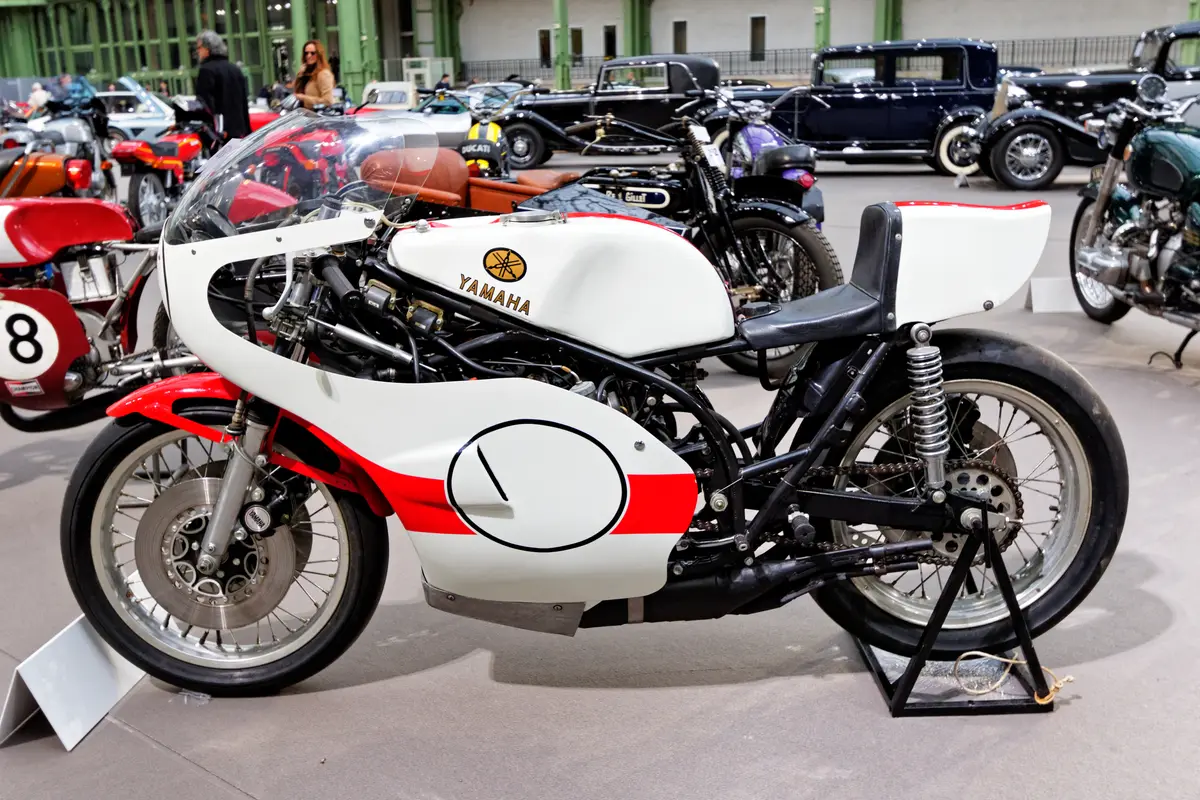
By Rahil "TorqueInductions" — I restore Yamaha's road-going two-strokes (an RD350, an RX100 and a Jawa 250) in my own garage; the TZ750 is the works-bred racing four that shares its bore and stroke with my 350. I've never owned one — only 567 exist — so what follows is the documented record, not a memoir.
Motorcyclist magazine called the TZ750 "the most notorious and successful roadracing motorcycle of the 1970s", and for once the magazine line undersells it. This was a production racing motorcycle — one any competitor could walk up and buy for $3,500 — that won the Daytona 200 nine years in a row, filled Formula 750 grids on two continents, took three world titles in the class, and frightened Kenny Roberts so thoroughly on a dirt track that the governing body banned its engine outright. Yamaha built just 567 of them between 1974 and 1979.
It is also, for this site, family. The TZ750's cylinders share their 64 × 54 mm dimensions with the road-going RD350, its crankshafts are built up and trued the same way as the twin's, and the whole improbable machine started life as a street bike that emissions laws strangled at birth. Here's the story with the numbers checked — because this is a bike whose legend has attracted a thick layer of invented specifications, including, until now, on this page.
A street bike that never was: where the TZ750 came from
The four-cylinder two-stroke wasn't designed as a racer at all. As Kevin Cameron told it in Cycle World's "The TZ Papers", Yamaha's 1972 Tokyo Motor Show shocker was a prototype rocketship: a two-stroke, reed-valve, four-cylinder 750 cc streetbike — the GL750. Tightening US emissions laws kept it out of showrooms, and the engine instead became a permanent revolution in racing.
The opening was Formula 750, a class meant for production-based superbikes, and the AMA's homologation rule: build 200 examples and you could race it. Yamaha's engineers got the go-ahead in October 1973, the machine was revealed at that year's Tokyo show, the pre-production prototype was tested in Japan by Kel Carruthers — Roberts' future tuner, then a former 250 cc world champion — and by December the 200 bikes were homologated. The US price was $3,500; in Britain, Chas Mortimer's purchase came to about £4,000 with a spares kit big enough to last most of a season, including two spare cylinder blocks and two spare crankshafts. Hold that spares list in mind. It tells you exactly what kind of machine this was.
Two crankshafts, running backwards: the engine
Look at a TZ750 engine and it reads as two TZ350 twins sharing a crankcase — because structurally, that's close to the truth. Cameron's description is the clearest ever written: a pair of 180-degree cranks, much like those in the production twins, set end to end. Thin gears at their inner ends meshed with a single double-width gear on a jackshaft, which drove the clutch, the water pump and a gearbox oil pump. Cylinders and heads were cast in pairs, just like the TZ350's, and TZ250 or 350 cylinders could be bolted straight onto the 750's crankcase. Bonhams' specialists add the honest footnote: for all the family resemblance, very few components were actually shared with the 350.
Each of those two cranks is a pressed-up assembly of webs, crankpins and rods — built, and later rebuilt, with the twins' rods, crankpins and bearings, exactly the construction I walk through in how a pressed two-stroke crankshaft is rebuilt and trued. Cameron records the working life of the pair: about 950 miles, with a rebuild's parts initially costing a dealer just over $100. The TZ750 simply has two of everything a twin has, including the bill.
The gear coupling produced the TZ750's strangest documented trait: the crankshafts rotated backwards, opposite to the usual direction, which put piston thrust on the exhaust-port side of the bore. Period examination of Mortimer's bike noted it in the spares kit itself — two built-up crankshafts, separate, with their central gears. The firing order matched the layout: cylinders 1 and 4 fired together, then 2 and 3 (per the long-running TZ350/250 reference). Around the cranks sat the rest of a serious racing specification: reed-valve induction — a first on a Yamaha road racer, shared only with the YZR500 Grand Prix bike, fitted to broaden what would otherwise have been an unusable powerband — four Mikuni VM34 carburettors, a six-speed gearbox built in unit with the engine, and four expansion chambers that, on the debut bikes, had an embarrassing habit of cracking. At Daytona in 1974 the early flat-section pipes broke up during the race and littered the track with fragments. The engine outran its exhausts before it outran anything else.
694 first, then the full 747: the A-to-F run
The 1974 original wasn't a 750 at all. With the 350 twins' 64 × 54 mm dimensions, capacity came out at 694 cc, and its factory designation was TZ700A. It was rated at 90 PS at 10,500 rpm and weighed 157 kg dry, in a new steel twin-shock frame that reminded paddock watchers of the Rob North chassis built for the BSA/Triumph triples. The full 747 cc engine — bore up to 66.4 mm — arrived with the second batch of Bs from October 1974.
One honest note on the middle years' power, because the references genuinely disagree: the standard model table (MacKellar's Yamaha two-stroke history, the source behind the table below) holds the factory rating at 90 PS for the B and C, while the TZ350/250 reference site lists both at 105 bhp. What's not disputed is the step that mattered: the 1977 D, rated at 120 PS. The D was, in Cameron's phrase, a productionized OW — the works OW31's formula (monoshock cantilever rear end, stiffer frame thinking, 152 kg) turned into the customer bike, replacing the twin shocks the C had been the last to carry. The E of 1978 was the big production year — 162 built — and the F closed the run in 1979, the year the FIM dropped Formula 750's world-championship status. Yamaha's own works riders, meanwhile, raced the OW31: a different animal in magnesium and titanium, which Yamaha's period data sheet credits with about 140 hp at 10,700 rpm and a maximum speed of "over 185 mph", and which Bonhams — quoting Yamaha's racing archive — says was ultimately developed to some 160 PS. When a spec sheet gives a production TZ750 140 hp, it has confused the customer bike with the works one. That confusion is where most of the internet's TZ750 numbers come from.
Common to all six models: liquid-cooled reed-valve two-stroke inline-four, six-speed gearbox, steel double-cradle frame, 7.3:1 compression (TZ reference table), twin-shock rear suspension on A–C and cantilever monoshock on D–F.
| Yamaha TZ750 — the verified numbers | TZ750A (1974) | TZ750B (1975) | TZ750C (1976) | TZ750D (1977) | TZ750E (1978) | TZ750F (1979) |
|---|---|---|---|---|---|---|
| Displacement | 694 cc | 747 cc | 747 cc | 747 cc | 747 cc | 747 cc |
| Bore × stroke | 64 × 54 mm | 66.4 × 54 mm | 66.4 × 54 mm | 66.4 × 54 mm | 66.4 × 54 mm | 66.4 × 54 mm |
| Factory power | 90 PS @ 10,500 rpm | 90 PS @ 10,500 rpm | 90 PS @ 10,500 rpm | 120 PS @ 10,500 rpm | 120 PS @ 11,000 rpm | 120 PS @ 11,000 rpm |
| Dry weight | 157 kg | 157 kg | 157 kg | 152 kg | 152 kg | 152 kg |
| Wheelbase | 1,407 mm | 1,407 mm | 1,407 mm | 1,390 mm | 1,390 mm | 1,390 mm |
| Built | 213 | 46 | 40 | 30 | 162 | 76 |
Production total: 567 — the model table sums to it exactly, and Bonhams states it outright. Auction copy that says "approximately 600" is rounding somebody else's homework.

Daytona: nine in a row, 1974–82
The TZ750's competition debut was the 1974 Daytona 200, and it set the pattern for everything after. Giacomo Agostini, newly arrived at Yamaha from MV Agusta, won it first time out. Kenny Roberts finished second, slowed by a cracked exhaust. Gene Romero was sixth. From there, the big TZ won Daytona nine consecutive times — a streak sourced not to fan memory but to Kel Carruthers' own history of the model, and repeated by Cameron: "an accident that won Daytona nine times in a row, from 1974–82".
The nine winners, because the list is the argument: Agostini (1974), Romero (1975), Johnny Cecotto (1976, beating the favourite, Roberts), Steve Baker (1977, in a rain-shortened race), Roberts (1978, finally), Dale Singleton (1979), Patrick Pons (1980), Singleton again (1981), and Graeme Crosby (1982) — who won on a parts-bin TZ750 after Roberts' disc-valve 500 Grand Prix bike seized. The factory men among them were on works OW31s; Singleton, twice, was a privateer. That's the TZ750's real claim on history, and Cameron built his TZ Papers around it: the bike made privateers into giant-slayers. In 1974 Cameron himself was tuning for 19-year-old Jim Evans, whose bought-over-the-counter TZ750 finished third at Talladega and Ontario with only the two factory Yamahas ahead of it and every other factory bike behind. No other maker offered a 750-class production racer at all. If you wanted to beat the factories, Yamaha would sell you the tool.
