
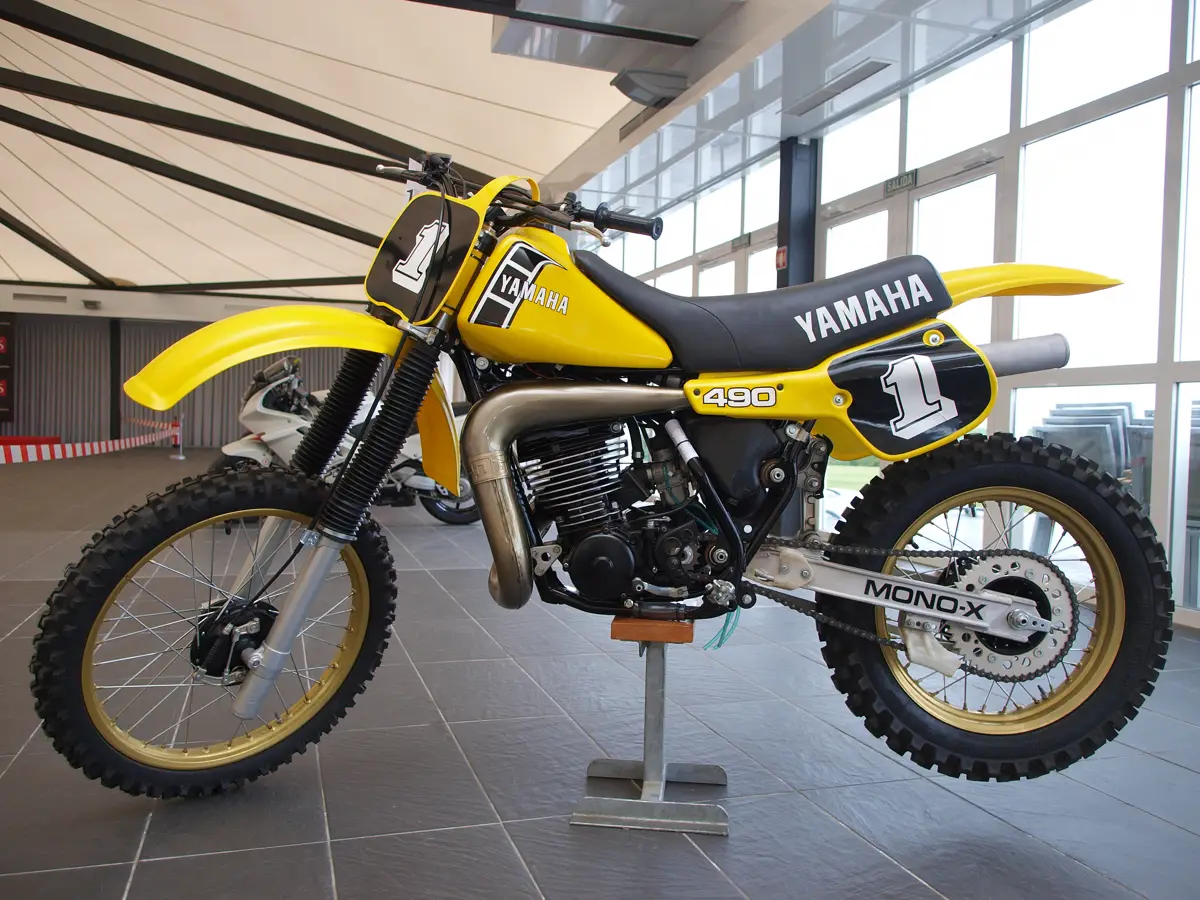
By Rahil "TorqueInductions" — I restore and ride two-stroke Yamahas here in India (an RD350, an RX100 and a Jawa 250) out of my own garage. I've never owned a YZ490, so this page sticks to what can actually be shown: factory figures labelled as factory, period magazine reporting labelled as period reporting.
The YZ490 is the open-class Yamaha that period testers loved and feared in roughly equal measure — a 487 cc air-cooled two-stroke single with a light-switch reputation, a list of faults the factory never quite fixed, and one achievement no fault list can take away: in 1985, Broc Glover won the AMA 500cc National Championship on a production-based YZ490, against full-factory works bikes that cost ten times as much. This is the bike's story with the numbers kept honest — including the ones Yamaha never published.
From the YZ465: why the 490 exists
The YZ490 did not appear in the late 1970s, whatever the internet keeps repeating. Yamaha's open-class line ran YZ400 (1976–79), then the YZ465 (1980–81) — a bike testers genuinely admired — and the 490 replaced the 465 for the 1982 season, its capacity up from 465 to 487 cc. Broc Glover had moved up to the 500 class in 1981 and won the national title in his first year in it, on the 465. The 490 inherited the crown, the rider and the expectations.
What it didn't inherit was the 465's good manners. The first YZ490 was heavier than the bike it replaced and, in Motocross Action's blunt retrospective summary, "nowhere near as reliable, difficult to start, had grim suspension, vibrated and was impossible to jet." That verdict is unfair to its engine's top-end strength and unfair to nobody else — the 490's faults were real, documented, and mostly carried through its whole nine-year life. We'll come back to them; they're half the reason the bike is interesting.
Yamaha YZ490 specifications: the numbers that matter
One warning before the table: the YZ490 changed more across its life than Yamaha's minimal-effort reputation suggests — gearbox, brakes and carburettor all differ by year, and any single "YZ490 spec sheet" that ignores that is copying somebody's guess. This one is for the model as a whole, with the year splits spelled out.
| Yamaha YZ490 — the numbers that matter | |
|---|---|
| Engine | 487 cc air-cooled two-stroke single, reed-valve induction, YEIS boost bottle |
| Bore × stroke | 87 × 82 mm |
| Carburettor | Mikuni VM38SS (first bikes); 40 mm Mikuni by 1984 |
| Gearbox | 4-speed (1982–85); 5-speed (1986–90) |
| Brakes | Drums front and rear (1982–84); front disc from 1985 (220 mm, 230 mm from 1988); rear drum throughout |
| Rear suspension | Monocross single shock (linkage repositioned below the swingarm for 1986) |
| Power | Quoted 47–55 hp depending on year and source — see the honesty section below |
| Top speed | Never published by Yamaha; no period instrumented figure exists |
| Weight | 223 lb is Hagerty's listed shipping weight (1985–88); period testers noted it was heavier than the YZ465 |
| Production | 1982–1990 model years |
For the full year-by-year breakdown — every model year's claimed power, weight, gearbox and brakes on one page — see the YZ490 specs by year hub.

Horsepower and top speed: the honest answer
These are the two questions this page gets asked most, and they deserve a straight answer rather than a copied one.
Horsepower. There is no single factory figure that covers the run, and the sources that do quote numbers disagree by year: Hagerty's valuation data lists the 1985 YZ490 at 55 hp and the 1987 and 1988 bikes at 47 hp. Period magazine dynos of open-class bikes in this era generally sat somewhere in that same broad band. What the period testers did agree on was the shape of the delivery: soft off the bottom for a 500, then a genuinely strong midrange and top end — PulpMX's retrospective calls the top-end power "particularly strong" and notes the bike could holeshot under the right conditions. Cycle World, testing the substantially updated 1984 bike, reckoned it "could be the fastest motocross bike ever built." So: quote a range, name your source, and be suspicious of anyone — including older versions of this page — who gives you one number with total confidence.
Top speed. Yamaha never published one, and no period magazine instrument-tested a motocrosser for top speed, 0–60 or braking distance. A YZ490's maximum velocity is a function of its motocross gearing — a four-speed (later five-speed) box chosen for starts and berms, not autobahns — and on stock gearing runs out of revs long before it runs out of power. The precise figures circulating on spec-aggregator sites (100 mph, 4.5-second 0–60, a 13-second quarter) appear in no period test we can find and are not repeated here. If that frustrates you, take it up with 1982: nobody at a motocross track cared, because the stopwatch that mattered measured lap times.
The faults were real: jetting, detonation and vibration
Motocross Action's fault catalogue for the YZ490 is the most quoted paragraph in the bike's history, and it earns the quoting: jetted rich enough to keep from seizing, the 490 "would blubber, foul plugs and produce little power. If you jetted it to run strong, it would detonate and seize. It came with air leaks, a wandering ignition, gimpy motor mounts and a bad case of Yama-swap! Yamaha issued a mountain of service bulletins to fix the problems, but none of them worked!"
Strip out the magazine theatre and three genuine engineering problems remain:
- The jetting knife-edge. The big Mikuni's window between blubbering-rich and detonating-lean was unusually narrow, and it moved with temperature and altitude. Yamaha was still trying to massage it away in 1987, when the head was reworked and the cylinder re-ported in the attempt.
- Chronic detonation. PulpMX's verdict is the definitive one: detonation "was a major issue on all the YZ490s and the problem never went completely away without having the head modified." The enduro sibling suffered the same way — Cycle World's 1983 test of the IT490K reported that "the engine pinged excessively, even at 5,000 ft elevation," and Yamaha issued a jetting bulletin in response. The fix the paddock settled on was reshaping the head's squish band, and it works by geometry, not folklore: this site's companion piece on the YZ490/IT490 squish band edge cut explains exactly what the modification does and what to measure — combustion chamber volume, squish clearance, the works — before any metal is cut. If you're measuring up a 490 head, the squish clearance calculator will help you sanity-check the numbers.
- Vibration. A 487 cc single with an 87 mm piston, no balancer and solid-era engine mounts was never going to be smooth, and period riders said so in unusually colourful language — "absurdly bad," "hand and mind-numbing." It is part of the bike's character now; in 1983 it was a reason to buy the Honda.
None of this made the 490 slow. It made it a specialist's bike: devastating for a rider who could jet it, time it and hold on; miserable for everyone else.
Year by year: what actually changed, 1982–1990
1982 — the launch. The 487 cc engine in a chassis closely related to the YZ465's: four-speed gearbox, drum brakes at both ends, 38 mm Mikuni. Heavier and harder-edged than the 465 it replaced, and the paddock noticed immediately.
1983 — the first title. Few changes of note; the year belongs to Broc Glover, who took the AMA 500cc National Championship on the YZ490 — the model's first title, and the second of Glover's three 500 crowns.
1984 — the big update. Cycle World called the '84 "truly new": a revised cylinder with an eight-petal reed cage in place of six, a radial cylinder head claimed to shed heat better, a centre-exit exhaust, a new frame with a wishbone-style front downtube, Z-type spokes and the 40 mm carburettor. Yamaha also abandoned its expensive works-bike programme this year and raced production-based machinery instead — a decision that defines the model's racing story.
1985 — Glover's year. A front disc brake at last, gold Takasago rims on the US bike, white bodywork with red and blue graphics in America — and BASS, the Brake Actuated Suspension System, a cable linking the rear brake pedal to the shock's compression damper to calm the rear end under braking. It was unique to 1985 and most riders disconnected it. The racing story of the year is below.
