A two-stroke crankshaft is pressed together — flywheel webs, crankpins and main journals interference-fitted around a connecting rod whose big-end is a closed eye with a caged roller bearing — so a rebuild means pressing it apart, fitting a new rod kit (pin, big-end bearing, rod and thrust washers, all from one maker), pressing it back together in a jig, and truing it: turning it between centres with dial gauges on the main journals and correcting the webs with a copper or lead hammer until runout is inside the maker's limit. Factory two-stroke manuals put that limit at 0.05 mm (0.002 in); Gordon Jennings' Two-Stroke Tuner's Handbook treats 0.001 in (0.025 mm) as the figure to aim for. On a twin, the two throws must also sit exactly 180° apart. The home checks that condemn a crank are radial (up-and-down) play at the rod — side-to-side float is normal and specified — rumbling main bearings, and crank seals that keep failing on the same side. US specialists charge roughly $230–$275 for
The original Yamaha RD125 (1973–80) is a 124 cc air-cooled two-stroke parallel twin — not the liquid-cooled single that took the RD125 name in 1982. Fed by twin 18 mm Teikei carburettors through reed-valve Torque Induction, it made a claimed 17 hp at 8,500 rpm with peak torque of 1.3 kgf·m at 8,000 rpm, through a five-speed gearbox, in a bike weighing 115 kg wet. It descended from Yamaha's AS3 twin and shared engine and chassis components with the RD200. Period testers called it the performance king of the 125 class; a 1981 British test measured about 14 bhp in the later, softer tune, with output nearly doubling between 6,000 and 8,000 rpm. In Britain it was a provisional-licence step-up bike until the Transport Act 1981's learner changes took effect on 1 February 1983, cutting learners to 125 cc with a 9 kW (12 bhp) power cap.
The Yamaha RD400 (model years 1976–79) is the 398 cc air-cooled two-stroke twin that replaced the RD350 — not by boring it out, but with a new crankshaft giving a longer 62 mm stroke (64 × 62 mm), new crankcases, barrels and head, and a rubber-mounted engine. Quoted power runs from 40 bhp at 7,000 rpm for the early bikes to a claimed 44 bhp for the revised 1978 RD400E, with 41.1 Nm of torque either way. It was the first production motorcycle from a major manufacturer offered with cast wheels (an option in 1976, standard by 1977), it offered a rear disc brake the 350 never had, and the line ended in 1979 with the RD400F — sold in the US as the white Daytona Special. Period tests recorded top speeds of 103–107 mph and standing quarters between 14.8 and 14.01 seconds depending on model year.
The Yamaha RD250 (1973–79) is a 247 cc air-cooled two-stroke twin making 30 hp at 7,500 rpm and weighing 152 kg dry. It shared its chassis, brakes and twin Mikuni VM28 carburettors with the RD350, was the first production road bike with reed-valve "Torque Induction" induction, and was MIRA-tested at 93.8 mph in 1973. In Britain it was the fastest motorcycle a learner could legally ride until the 125 cc learner limit arrived in February 1983.
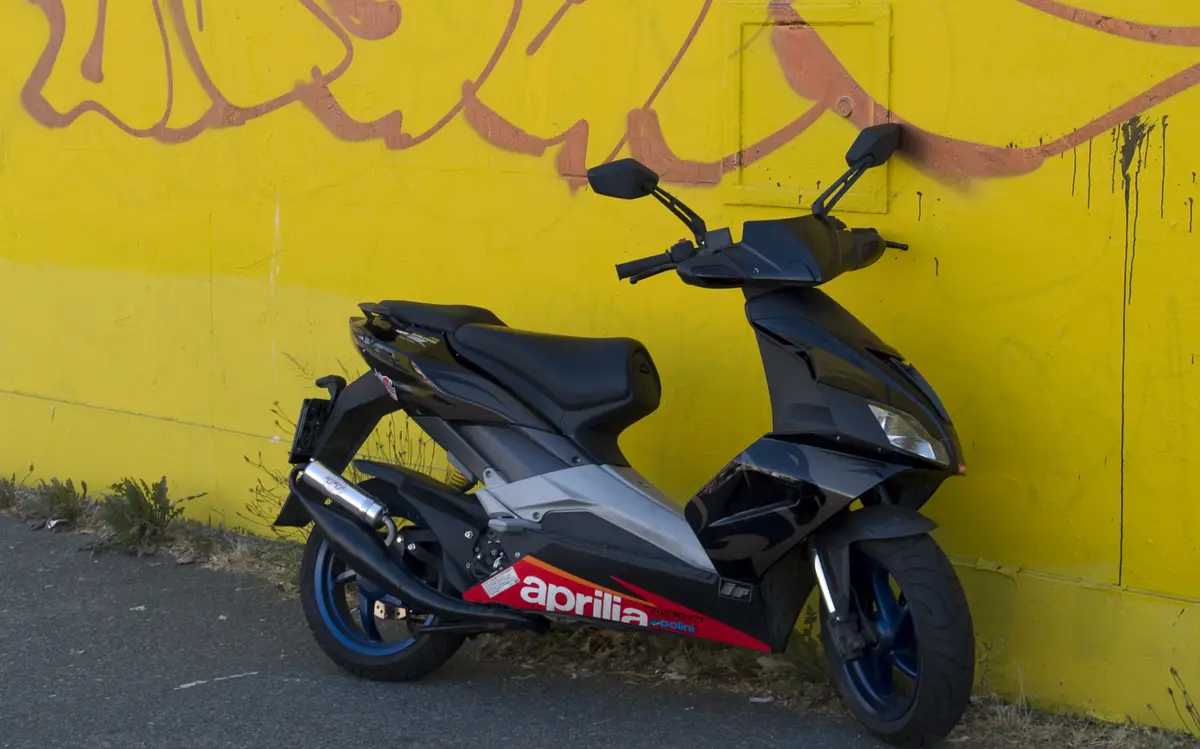
Aprilia DiTech (2000) was an air-assisted direct-injection two-stroke built under licence from Australia's Orbital and fitted to the SR 50 scooter. A crank-driven compressor supplied air at about 5 bar, fuel was metered into an air-fuel rail, and a direct injector fired the mixture into the cylinder after the exhaust port had closed — so fresh fuel could no longer short-circuit out of the exhaust. Aprilia claimed 40% lower fuel consumption, 60% lower oil consumption and 80% lower pollutant emissions than a carburetted 50, and the system met Euro 2. The production hardware was built by Synerject, the Orbital–Siemens joint venture. DiTech also powered the Scarabeo 50; Piaggio's PureJet and Peugeot's TSDI used the same licensed technology. It faded because the hardware was expensive for a 50 cc scooter, the compressor system collected condensation water, the Euro limits kept moving, and cheap fuel-injected four-strokes undercut it. Orbital's injection survived at sea in Mercury OptiMax ou
The Yamaha RX100 was a 98.2 cc air-cooled two-stroke single built in India by the Escorts Group with Yamaha, from November 1985 to March 1996. Based on Yamaha's RX-S and first assembled from Japanese CKD kits (full Indian production followed after 1990), it made 11 PS at 7,500 rpm and 10.39 Nm at 6,500 rpm, weighed 103 kg dry, and was good for about 100 km/h — figures that made it, by a wide margin, the fastest 100 cc motorcycle on sale in India, against commuter rivals like the 8.25 bhp Ind-Suzuki AX100. It cost roughly ₹19,000 at launch, was killed by tightening emission norms rather than falling demand, and was followed by the 132 cc RXG, RX-Z and RX135, none of which displaced it. Good original examples now change hands for ₹80,000 to ₹2 lakh.
Most of what a classic motorcycle does to its rider is measurable and much of it is fixable at the bike. The dominant noise exposure is wind, not exhaust: the University of Southampton's ISVR programme found wind noise overtakes the machine's own noise above about 65 km/h, with 97–104 dB(A) measured at the ear at 70 mph — levels at which NIOSH's exposure rule (85 dBA for 8 hours, halving with every 3 dB) allows only minutes. Excess vibration on an RD350 is usually a fault (carb sync, timing balance, engine mounts) rather than a trait, and the occupational hand-arm vibration values published by the HSE (action value 2.5 m/s² A(8), limit 5 m/s² A(8)) are power-tool workplace figures with no motorcycle equivalent. Back and wrist pain on a vintage bike is usually bar position and collapsed seat foam; fatigue is managed with the Highway Code's break rule — at least 15 minutes every two hours — which an RD350's 15.5-litre tank enforces anyway.
Is an RD350 a better investment than the S&P 500? Hagerty values a good RD350B at $4,700 (June 2026, down 4.1%); the index compounded at about 10% a year for a century. Recorded sales, real costs, and the answer.
How micro-perforated mufflers silence a two-stroke with no wool to burn out — hole size, porosity, cavity tuning and pressure drop, the one SAE motorcycle silencer that used them, and what the stinger has to say about it.
There is no mainstream loan product for restoring a motorcycle: the specialist collector lenders finance purchases of finished vehicles (Woodside Credit's published terms require an operational vehicle 25 years or older and a minimum purchase price of $20,000), so RD350 restorations are funded from savings in phases, unsecured personal loans, or 0% credit-card periods. The rate anchors, checked in November 2026: the Federal Reserve's G.19 release puts the average US 24-month personal loan at commercial banks at 11.90% (August 2026) and the average APR on interest-charged card accounts at 22.36%; MoneySavingExpert's UK best buys start at 5.9% representative APR for £7,500–£15,000, and UK 0% purchase cards run up to 25 months. On cost, the one published machining anchor is HVCcycle's price list: a twin-cylinder Yamaha RD crank overhaul is $440 labour plus parts. And the ceiling matters more than the budget: Hagerty's Price Guide (June 2026) values a 1973 RD350 at $11,300 in #1 Concours c
Turbocharging a Yamaha RD350 is physically possible but fights the engine's operating principle. A crankcase-scavenged two-stroke breathes by pressure difference: the descending piston pressurises the crankcase and pushes fresh charge through the transfer ports while the exhaust port is still open, and the expansion chamber's returning pressure wave stuffs escaping charge back in — the effect Gordon Jennings called the two-stroke's built-in supercharging. A turbocharger disturbs both halves of that system: its turbine restricts the exhaust and raises back pressure against scavenging, and pressurised intake charge can short-circuit straight out of the open exhaust port. Every factory turbo motorcycle of the 1980s (Honda CX500 Turbo, Yamaha XJ650 Turbo, Suzuki XN85, Kawasaki GPz750 Turbo) was a four-stroke. The only factory turbocharged two-stroke, Rotax's 850 E-TEC Turbo snowmobile engine of 2020, was designed around its turbo from the start, uses direct injection and an ECU-controlled
Classic motorcycle insurance differs from standard cover in one load-bearing way: how the bike is valued when it is stolen or written off. An agreed-value policy writes the figure into the policy schedule before the policy starts — Footman James defines it as being paid "the amount shown on your policy schedule… regardless of the market value at the time of the loss" — while a standard policy settles at a depreciated actual cash value decided at claim time, and a stated-value policy caps the payout at the lesser of the stated figure or that same cash value. Eligibility is published and checkable: Hagerty insures motorcycles of model year 1996 and older with a minimum value of $2,000, modified bikes included, and excludes on-track use; Footman James counts a bike as classic at 15 years old; Bikesure generally uses 30 years with modern-classic exceptions. In India there is no published agreed-value classic bike product; the equivalent lever is the motor tariff rule that the IDV of a vehi