Harley-Davidson M50 (1965–66): the 49.6 cc Aermacchi-built two-stroke that is the smallest Harley ever sold — 2.5 hp, 103 lb, twist-grip gears, the M-50 Sport, the M-65 that followed, and what one is worth now.
On a Yamaha, RD is most widely read as "Race Developed" — the name given to Yamaha's two-stroke sports twins when the range launched in 1973 with the RD250 and RD350. The reading is genuinely contested: Yamaha's own model codes suggest RD may simply be a factory designation (R for road, D for two-stroke, the same pattern as DT and XS), with "Race Developed" popularised later by UK marketing, and some Indian sources print "Race Derived" instead. What is not contested is the hardware: reed-valve two-stroke twins derived from Yamaha's production racers, spanning the 124 cc RD125 twin to the 499 cc RD500LC V4, and built in India by Escorts from 1983 as the Rajdoot 350.
Restoring a Buell is harder than restoring most classics for one structural reason: the marque is an orphan. Harley-Davidson discontinued Buell on 15 October 2009 after building 136,923 motorcycles, and its promise to supply parts through dealers — quoted at the time as parts availability "for up to 10 years" — has long expired, so the owner community, donor bikes and a handful of specialists are now the supply chain. On top of that sit challenges no other marque combines: the XB's aluminium frame is its 3.7-gallon fuel tank and its swingarm carries the engine oil; the injected bikes run Buell's DDFI system, whose factory fuel-pressure test value is 49–51 psi, with diagnostics now handled by community software (ECMSpy, ECMDroid) rather than dealers; and the range covers three unrelated engine families — Sportster-based pushrod twins, the Blast's 492 cc Sportster-derived single (not a Rotax — the Rotax engine is the liquid-cooled 1,125 cc Helicon V-twin in the 1125R and 1125CR), each wi
"Ceramic coating" is two different products — high-temp exhaust ceramic (Cerakote, Jet-Hot) and detailing nano-ceramic for paint. Which belongs on a vintage bike's headers, original paint and chrome, what each really costs, and where neither is worth the money.
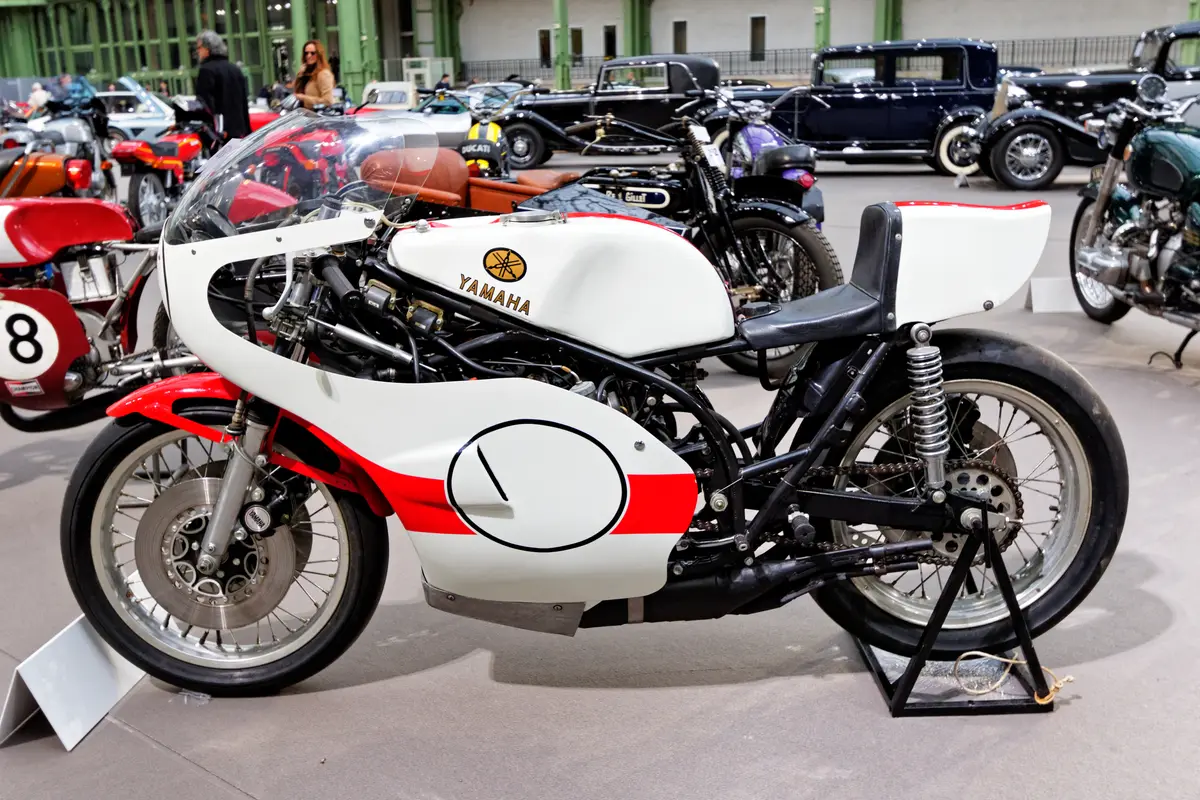
The Yamaha TZ750 is a series-production two-stroke racing motorcycle built from 1974 to 1979 for Formula 750. Its liquid-cooled inline-four used two 180-degree crankshafts set end to end in a common crankcase, coupled by centre gears to a jackshaft — an arrangement that made the cranks rotate backwards. The 1974 original displaced 694 cc (64 × 54 mm, the RD350's dimensions) and was rated at 90 PS; the full 747 cc version (66.4 × 54 mm) arrived with the B, and the monoshock 1977 D was rated at 120 PS. Only 567 were built. TZ750s won the Daytona 200 nine years running, 1974–82 (Agostini, Romero, Cecotto, Baker, Roberts, Singleton, Pons, Singleton, Crosby), and took the Formula 750 world title in 1977 (Steve Baker), 1978 (Johnny Cecotto) and 1979 (Patrick Pons). In 1975 Kenny Roberts won the Indy Mile dirt-track race on a TZ750-engined flat tracker built by his tuner Kel Carruthers; the AMA banned the engine from dirt track, and Roberts' verdict — "They don't pay me enough to ride that th
Harley-Davidson Baja 100 (1970–73): the Aermacchi-built 98 cc two-stroke that won its class at the 1971 Baja 1000 — sleeved-down Rapido engine, MSR vs SR, 8B/8C frame numbers, production runs and what one is worth now.
The Harley-Davidson RR250 — Aermacchi's 246 cc two-stroke Grand Prix twin that won the 250 cc world championship in 1974, 1975 and 1976 with Walter Villa. Verified specs, Pasolini's one-point season, and the Loudon win the old page dated wrong.
How to restore a classic motorcycle stage by stage — assess, paperwork, strip, frame, engine, carbs, electrics, paint — with the machining numbers measured, not guessed.
Rare vintage motorcycles worth restoring — the seven that pass the three-question test, with Hagerty guide values: Ducati 750 Sport, Kawasaki H2, Norton Commando, Honda CBX, Laverda Jota, BSA Rocket 3 and Moto Guzzi V7 Sport, plus the checks that separate a gem from a lawn ornament.
Torque is twisting force: a force multiplied by the length of the lever it acts through (τ = F × r), measured in newton-metres (N·m) or pound-feet (lb-ft) — 50 N on a 20 cm spanner is 10 N·m. Horsepower is not a rival quantity but torque put to work at speed: hp = torque (lb-ft) × rpm ÷ 5,252, which is why torque and horsepower curves plotted on the same scale always cross at 5,252 rpm (in metric units, kW = N·m × rpm ÷ 9,549). Gearing multiplies torque at the rear wheel — a 39-tooth rear sprocket swapped for a 42-tooth gives 7.7% more wheel torque and 7.1% less road speed per gear. A US-spec RD350B's factory figure is 39 bhp at 7,500 rpm (rd350.info/specifications), which means it is making 27.3 lb-ft (37.0 N·m) at that speed; the Indian High Torque version's period-quoted peak was 3.3 kg·m (32.3 N·m) at 6,500 rpm.
Should you convert a classic motorcycle to electric? What conversions really involve, what Electrogenic, Beachman and the eCUB kit charge, why reversible is the only sane way — and why India currently has no legal route for an RD350.
The Harley-Davidson RR350: Aermacchi's 347cc Grand Prix twin and Walter Villa's 1976 350cc world title — verified specs, the honest season-by-season record, and how many were really built.