Harley-Davidson SX125 and SXT-125 (1974–78): the Aermacchi-built two-stroke trail bikes from Harley's Italian years — 123 cc factory specs, the SX/SXT split, 7A and 3F number codes, and what one is worth today.
The Yamaha RD350 runs two 28 mm Mikuni VM28 carburetors, one per cylinder, and they are tuned as a matched pair: clean first, then set a stock baseline (140 main jet, 25 pilot jet, needle clip in the middle notch, idle 1,200–1,300 rpm), set the idle and air screws for the highest smooth idle with both screws kept even, work the needle for the mid-range, prove the main jet with a full-throttle plug chop, and finish by synchronising the slides so both cylinders pull together.
The Yamaha RD500LC (1984–1986) was Yamaha's road-going replica of its YZR500 Grand Prix racer: a 499 cc, 50-degree, twin-crankshaft V4 two-stroke with YPVS power valves, for which Yamaha claimed 88 hp at 9,500 rpm (factory). It weighed 205 kg dry (factory), and MCN's first road test recorded 148 mph on the test strip (period test). It was sold as the RZ500 in Canada and Australia, never officially sold in the USA because of EPA emissions rules, and Japan got the RZV500R — a limited run of 1,600 units with a hand-welded aluminium frame and the engine detuned to 64 hp for Japanese law. Production ended in 1986.
Jawa 250 Pérák parts, sourced honestly: the Czech catalogues that stock the type 11, where originals turn up, what the bike is worth, and how to spot fakes.
The Honda NSR250R is a street-legal 249 cc two-stroke sport bike Honda built from 1987 to 1999 across four generations — MC16, MC18, MC21 and MC28 — each powered by a liquid-cooled 90° V-twin with crankcase reed-valve induction, Honda's RC-Valve exhaust power valve and a six-speed cassette gearbox. It was officially a Japanese-market bike, sold under the manufacturers' voluntary limits: 45 PS at 9,500 rpm for the MC16 to MC21, and 40 PS for the MC28 after the class limit dropped, plus a 180 km/h speed restriction. Derestricted, the standard engine makes roughly 57–60 hp. The MC21 (1990–93) added the Gull-Arm swingarm and PGM-III engine management that reads gear position and throttle opening; the MC28 (1994–99) finished the line with a single-sided Pro-Arm swingarm and PGM-IV ignition whose map lives on a removable memory card. Dry weights ran from 132 kg (MC21) to about 138 kg (MC28), fuel capacity was 16 litres throughout, and SP versions added a dry clutch and magnesium wheels. Ther
The Kawasaki H1 Mach III (1969–75, then the detuned KH500 for 1976) is a 498 cc air-cooled piston-port two-stroke triple with three Mikuni VM28SC carburettors and a factory claim of 60 hp at 7,500 rpm. Keeping one alive starts with identifying the variant, because the systems changed by year: the oil pump (Kawasaki's Injectolube) meters oil by engine speed and throttle and feeds the crankshaft main and big-end bearings directly as well as the intake side, so the bike cannot be run on premix alone; the ignition is a distributor-type CDI for 1969–71 (UK bikes used points), breaker points for 1972, and the H2-type CDI from 1973, revised again for 1974; the gearbox is five-up with neutral at the bottom until the KH500's conventional 1-down/4-up pattern; and the brakes are a 200 mm twin-leading-shoe front drum until the 296 mm front disc arrives for 1972. NGK's application chart lists the B9HS-10 plug, gapped 0.9–1.0 mm.
RD350 performance mods work as a system, in this order: first make sure the stock engine is healthy, then expansion chambers (the biggest single change), then carburetor jetting to match the chambers (mains typically move from the stock #140 into the 160–220 range), then reed valves, electronic ignition for reliability, and only then porting, head work or a big bore. Every power step needs its supporting work — jetting after any airflow change, and brakes, tyres and suspension sorted before the engine makes the bike faster than its chassis.
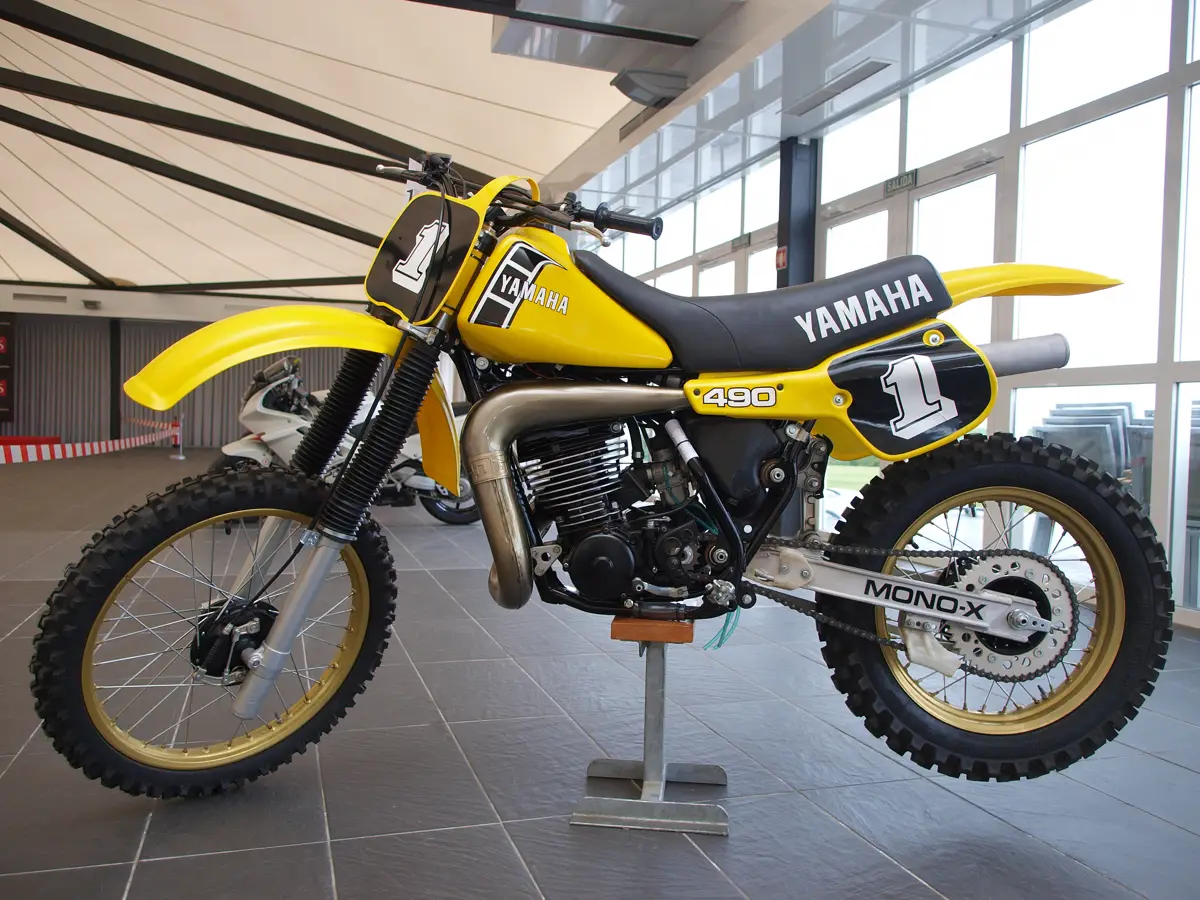
The Yamaha YZ490 is an air-cooled 487 cc two-stroke single-cylinder motocross bike built from 1982 to 1990 as the successor to the YZ465. It ran a reed-valve engine of 87 × 82 mm with a YEIS boost bottle, a four-speed gearbox until a fifth gear arrived in 1986, drum brakes until a front disc appeared in 1985, and no water cooling or power valve in a class that adopted both. Period and modern sources quote its power anywhere between 47 and 55 hp depending on year; Yamaha never published a top speed. It was notorious for a jetting knife-edge — jetted rich it blubbered, jetted lean it detonated — and for chronic pinging that owners cured with a cylinder-head modification. Its racing fame rests on Broc Glover, who won the AMA 500cc National Championship on it in 1983 and again in 1985, the second time on a production-based bike against Honda's works machinery.
YPVS — Yamaha Power Valve System — is a servo-driven rotary valve in the exhaust port of the liquid-cooled RD350 (1983–86, sold as the RZ350 in the US) that raises and lowers the effective exhaust port height with rpm, so the engine keeps low-rev torque and still makes top-end power. Most "YPVS tuning" is not modification at all: it is making sure the valve is clean, the cables are correctly routed and adjusted (No.1 to No.1, No.2 to No.2), and the pulley is set on its rigging-pin datum so the valve sits flush with the port roof at full open. A valve stuck closed kills the top end, a valve stuck open kills the bottom end, and a silent servo at key-on means an electrical fault — fuse, connections, servo or control box — before it means a mechanical one.
As of November 2026, Yamaha has never announced an RD350 relaunch — no statement, no concept bike, no launch date. The "RD350 launched" stories come from content farms with invented specs and prices (the same imaginary bike is ₹65,000 on one site and ₹3.35 lakh on another), and the only classic Yamaha has discussed reviving on the record is the RX100 — as a name on a future new model, with a two-stroke engine ruled out by its own chairman.
The Triumph Tina and T10: Edward Turner's 100 cc automatic shopping scooter, the CVT that jammed solid, the Cliff Richard campaign, the 1965 rename, corrected specs and recorded Bonhams prices.
An expansion chamber is a tuned exhaust for a two-stroke that uses pressure waves instead of valves: the diverging diffuser cone reflects a low-pressure wave that helps pull burnt gas out of the cylinder and draw fresh fuel-air charge in, and the converging baffle cone reflects a high-pressure wave timed to arrive just before the exhaust port closes, pushing escaping fresh charge back into the cylinder so more of it burns. On a Yamaha RD350 a pair of chambers (one per cylinder) moves the powerband higher and makes it stronger inside a narrower rev range, at the cost of a flatter feel below the band and a lot more noise. Because chambers make the engine pass more air, fitting them without re-jetting — going up from the stock #140 main jets and proving the result with plug chops — runs the engine lean at full throttle and risks a seizure.